

Emilabel continues its growth path in the label sector, between flexography and digital, with the introduction of the new Durst TAU 340 RSC E-Led, marking a new leap in terms of quality, efficiency, and production flexibility, while also strengthening the central role of people within the company
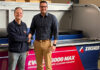
“Before we begin telling the story and evolution of Emilabel, we would kindly ask you to dedicate this interview to our father Romeo, who passed away about a year ago, because if we are here today, we owe it to him and to his courage in embarking on this adventure, in which he subsequently involved us too”, begin Matteo and Luisa Venturi, who now lead the company. A young and dynamic business based in Novi di Modena, with 25 employees, a turnover of around €5 million, and a strong desire to grow and explore new markets, while remaining firmly anchored to the principles inherited from their father Romeo: ethics, people-centred values, attention to quality, and utmost care in customer service.
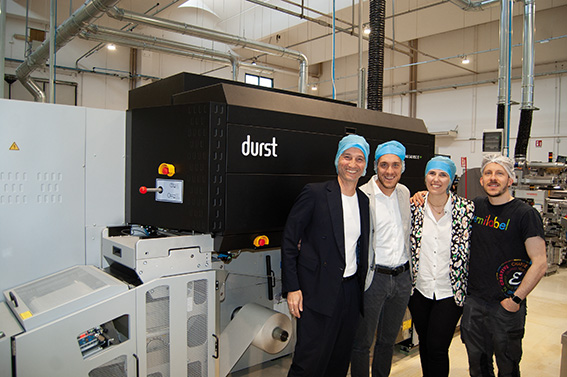
Walking into Emilabel means breathing an authentic family atmosphere, built on genuine relationships and a daily workflow that feels natural and seamless. This is something you perceive immediately, even before talking about machines, technologies, or markets. Some companies define themselves through numbers, others through people, Emilabel undoubtedly belongs to the latter. Matteo and Luisa welcome us with simplicity and a touch of emotion, as this is their first interview for a trade magazine.
A story built step by step, always with labels as the core business
Emilabel was founded in 1984 from an idea by Romeo Venturi, already active in the sector as a sales agent for an important label company in Milan. The initial idea was to establish a production business in the Emilia region at a time when the market was beginning to show promising signs of growth. After an initial phase of collaboration with other partners, Romeo decided to continue independently, gradually building a solid, rooted, and constantly evolving company.
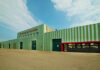
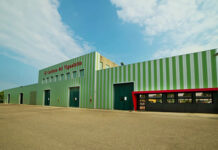
The generational transition, with Matteo joining in the 1990s and later his sister Luisa, marked a new acceleration in development. Over the years, Emilabel grew, relocated, invested, and structured itself, reaching its current setup: a modern, efficient, company-owned production facility, with concrete prospects for further expansion due to increasing space saturation. One element, however, has remained unchanged: attention to the customer and the desire to maintain a clear identity. “We have always preferred to do well what we know, rather than chase everything”, says Matteo.
The technological journey has followed the natural evolution of the sector, moving from letterpress to flexography, which for years represented the company’s production core. The move into digital began about five years ago as an important first step, leaving room for further technological evaluation and comparison.
The choice of Durst: quality, reliability, and vision
The path leading to the introduction of the Durst TAU 340 RSC E-Led stems from an in-depth market analysis, comparative testing, and visits to the demo center in Brixen. “We tested the same jobs with different technology providers, and in the end, the quality we saw with Durst was objectively superior”, they explain.
However, the decision was not based solely on print quality. Other decisive factors included system reliability, ease of management, software robustness, efficient service, and the proximity of technical support. “When you invest in digital, the system must always work, you can’t afford downtime. And having nearby support makes all the difference”, adds Matteo Venturi. Also noteworthy is how Emilabel experienced Durst’s approach, which provided continuous support from the testing phase to the commercial stage, through to installation and operator training.
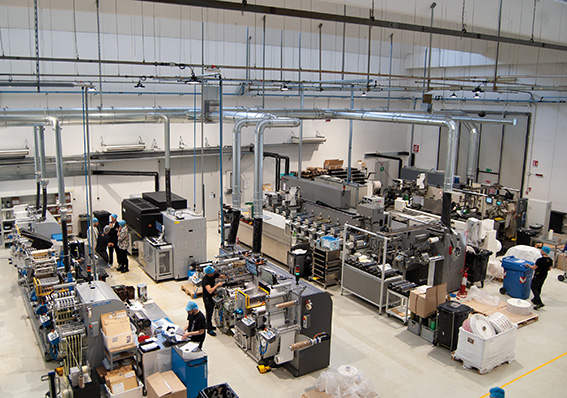
Durst TAU 340 RSC E-Led: features and advantages
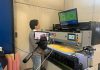
The chosen configuration is CMYK plus white, based on UV LED inkjet technology. The machine ensures speeds of up to 52 meters per minute even with white, high print quality, and a color reproduction capability reaching approximately 85% of the Pantone range, with the possibility of future upgrades with additional spot colors. LED technology also enables a significant reduction in energy consumption and maintenance, thanks to the absence of traditional lamps and reduced use of consumables. All of this fits into an increasingly sustainability-oriented approach, with less waste and greater overall efficiency in the production process.
At Emilabel, digital does not replace flexography but complements it in a logic of production optimization. “Today we analyze each job and decide where it is most efficient to produce it. The trend is clear: shorter runs, greater fragmentation, and increasingly advanced versioning. The customer doesn’t ask how you print, they want the right product, at the right price, at the right time”, says Matteo. More and more jobs previously produced in flexo are being shifted to digital, especially when runs decrease or variants increase.
New opportunities: beverage and dynamic markets
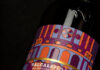
The installation of the new machine also opens up interesting commercial opportunities, particularly in the beverage sector, where Emilabel is strengthening its positioning. “Previously, we were not competitive on certain jobs. Today, with TAU, we can compete confidently, knowing we can guarantee top-quality products and a level of service that continues to make the difference. In addition to the wine & spirits sector, we are also targeting new markets that are more dynamic and open to innovation”.
One of the most interesting aspects emerging from the interview concerns the internal impact of the investment. “This machine has brought freshness, not just in productivity and quality, but also enthusiasm, engagement, and curiosity”. Digital changes the way of working, introduces greater opportunities for experimentation, and makes it easier to correct and improve jobs. This strengthens integration between departments and increases overall responsibility. The graphics department also benefits from this new dynamic, as does production as a whole.
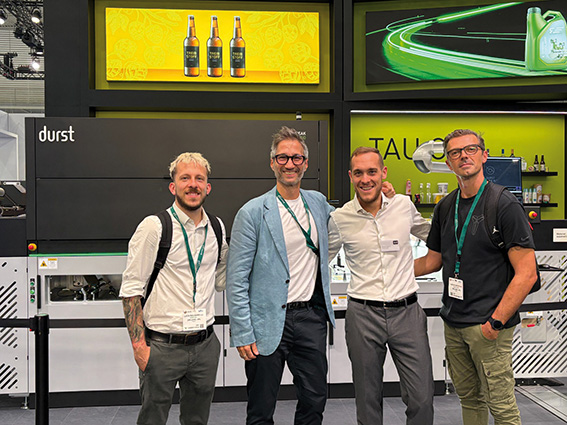
A complex market, between pressures and opportunities
The market scenario remains complex, especially due to raw material dynamics and their volatility. In this context, digital also represents a tool to better manage uncertainty, thanks to greater predictability of costs and results.
Emilabel’s outlook remains focused on the future with pragmatism. The company intends to continue its digitalization path, invest in staff training, maintain technological flexibility, and, in the medium term, consider introducing a second digital or hybrid machine. “This investment has brought dynamism, speed, and above all, a new energy into the company”, concludes Matteo Venturi.
Beyond machines, markets, and strategies, what clearly emerges from the meeting with Matteo and Luisa is their strong connection to the company’s original imprint, still evident today in their relationships with people, their professionalism, and their ability to look to the future while staying true to their identity. A legacy that lives on every day, still bearing the discreet yet profound signature of Romeo Venturi.