


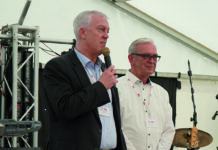
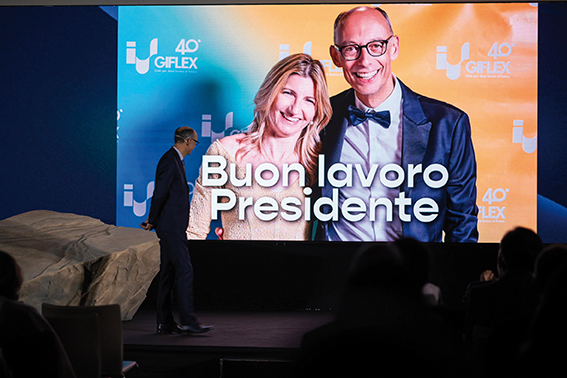
Neni Rossini, In your speech, you said that you were “born in Giflex”. Now that you have become its president, which values and lessons passed down by previous generations do you carry with you, and what personal contribution would you like to make to the association?
“It’s true, Giflex is part of my story even before it became part of my professional journey. As a child, I attended association meetings and events alongside my mother, and that privileged perspective allowed me to experience this organization in a very special way: through people, families, and entrepreneurs who, through their work and vision, built something lasting. I got to know the faces and the values before I got to know the companies. The values I absorbed during those years are the same ones I still see in our companies today: integrity, responsibility, fairness, a strong work ethic, and respect for people. But also an awareness of the value of unity. There are challenges that affect all of us and can only be addressed by bringing together different skills, experiences, and perspectives. From this comes the ability to listen, to work as a system, and to collaborate in creating value for the entire sector. After all, working in packaging means taking on a tangible responsibility toward society. The products that our packaging protect become part of people’s daily lives, and that requires an ethical and industrial standard that cannot be compromised. The contribution I would like to make is building on these foundations, further strengthening the cohesion of the association while expanding our ability to create networks in an increasingly European and global context. The challenges we face today do not stop at national borders and require responses that match this complexity”.
If you had to identify the challenge that will most shape the future of flexible packaging in the coming years, what would it be?
“If I had to choose just one, I would say that the most important and complex challenge will be finding solutions capable of simultaneously reducing environmental impact, using resources more efficiently, delivering high performance, and remaining economically accessible. True sustainability lies precisely in the ability to balance these different elements and advance them together, because a solution that excels in only one area while failing in others can hardly be considered an effective and lasting answer. Our sector is working hard to develop packaging that uses resources more efficiently, has a lower environmental impact throughout its lifecycle, and is designed to be more easily recovered, recycled, and reintegrated into the circular economy. This is a necessary direction, and the progress made in recent years demonstrates that. However, it would be naïve and inaccurate to consider environmental performance as the only variable at play. Packaging that achieves maximum circularity but cannot adequately protect the product it contains fails in its primary purpose. Likewise, packaging that delivers outstanding environmental and functional performance but comes at a cost so high that it becomes inaccessible to most consumers and manufacturers is not a viable solution. Authentic sustainability is not what works in a laboratory or in policy documents; it is what works in the marketplace, in real life, and at industrial scale. This challenge requires technological innovation, systems thinking, and deep collaboration throughout the value chain, from materials research and packaging design to collection and recycling systems, as well as the industrial policies needed to support and enable this transition. And our sector has the expertise to meet that challenge”.
During the congress, it emerged the possibility that the PPWR could be revised. How concerned are member companies about this scenario, and what role should Giflex play in protecting the sector during such a delicate phase?
“We are in a period of significant regulatory complexity, and all our member companies clearly feel it. PPWR represents a structural milestone for the future of packaging. It is not merely a matter of regulatory compliance; it concerns how the entire industry will be required to evolve in the coming years. Translating political objectives into practical rules and coherent targets requires time, technical expertise, and continuous dialogue between institutions and industry. We recognize that the regulation, in its current form, contains aspects that require substantial clarification and refinement, and we certainly cannot claim to be completely satisfied with every provision. At the same time, however, we believe it provides a foundation on which it is both possible and necessary to build. For this reason, the prospect of reopening the entire regulation is a serious concern, one that we fully share with our European colleagues at Flexible Packaging Europe (FPE). Reopening the text would not automatically improve it. Instead, it would risk undoing a difficult process that has already achieved some important balances, further delaying the establishment of rules that the sector urgently needs, and above all creating new uncertainty at precisely the moment when companies are seeking stability and clarity. We believe it is far more sensible and constructive to focus efforts on secondary legislation, namely implementing acts and operational guidelines. This is where the aspects that remain insufficiently defined can be clarified, improved, and made genuinely workable in industrial practice. Giflex’s contribution, together with that of other industry associations, will be crucial in bringing the sector’s technical expertise, practical industrial experience, and the results of years of research and innovation to the appropriate decision-making forums. Through this commitment, we fulfill our role as an active and authoritative stakeholder in shaping rules that are ambitious in their objectives and credible in their implementation”.
Flexible packaging is often at the center of environmental debates. In your view, what is the biggest misconception that continues to shape perceptions of the sector, and what should we do to better communicate its value?
“I believe the most widespread misconception is that packaging is judged almost exclusively at the end of its life, without considering the value it creates throughout its entire lifecycle. Packaging pays the price for its own effectiveness: when it performs its role well, it becomes almost invisible. We do not notice the packaging itself; we notice the intact product on the shelf, the food that lasts longer, and the safety ensured during transportation and distribution. Only when its function is over, it suddenly becomes visible, and at that point it is perceived merely as waste, a problem to be managed. This cognitive disconnect lies at the root of many distorted perceptions of our sector. In reality, we know how crucial it is to evaluate packaging’s contribution to the entire system. Communicating this effectively is one of the most demanding communication challenges we face. As an industry, we have a responsibility to participate in this dialogue with transparency, expertise, and credibility, helping to build greater awareness of the real value that packaging creates every day”.
If we were speaking again at the end of your term, what concrete achievement would you most like to point to as Giflex’s and the Italian flexible packaging sector’s greatest success?

“I would like to be able to say that Italian flexible packaging is recognized as an authoritative point of reference in decision-making processes, both in Italy and across Europe, not simply as a representative of sector interests, but as an expression of world-class technical, scientific, and industrial expertise capable of making a meaningful contribution to the development of effective and realistic policies. We are living through a period in which regulatory decisions will profoundly shape the future of innovation, sustainability, and industrial competitiveness in Europe. Being present, prepared, and heard in these discussions is a responsibility we owe to companies and to the broader economic and industrial system of which we are part. Alongside this institutional objective, there is another goal that is equally important to me: seeing flexible packaging recognized as a sector capable of attracting talent and new generations. We are an industry that combines manufacturing excellence, technological innovation, complex sustainability challenges, and international openness. We have everything needed to be perceived as an environment where people can build stimulating, meaningful, and long-term careers. If, in a few years’ time, we could say that we helped strengthen both of these aspects, the sector’s authority in the places where rules are shaped and its ability to attract new people, skills, and energy, I would consider that an important achievement for Giflex and for the entire industry”.