




CHINAPLAS, the world’s largest plastics and rubber trade fair, returns to Shanghai and once again surpasses itself. Four days, 390,000 square meters, over 350,000 visitors. Energy, innovation, guidelines. CHINAPLAS 2026 is not just a trade fair: it is a snapshot of a market that is accelerating, structuring itself, and asking to be observed with fresh eyes
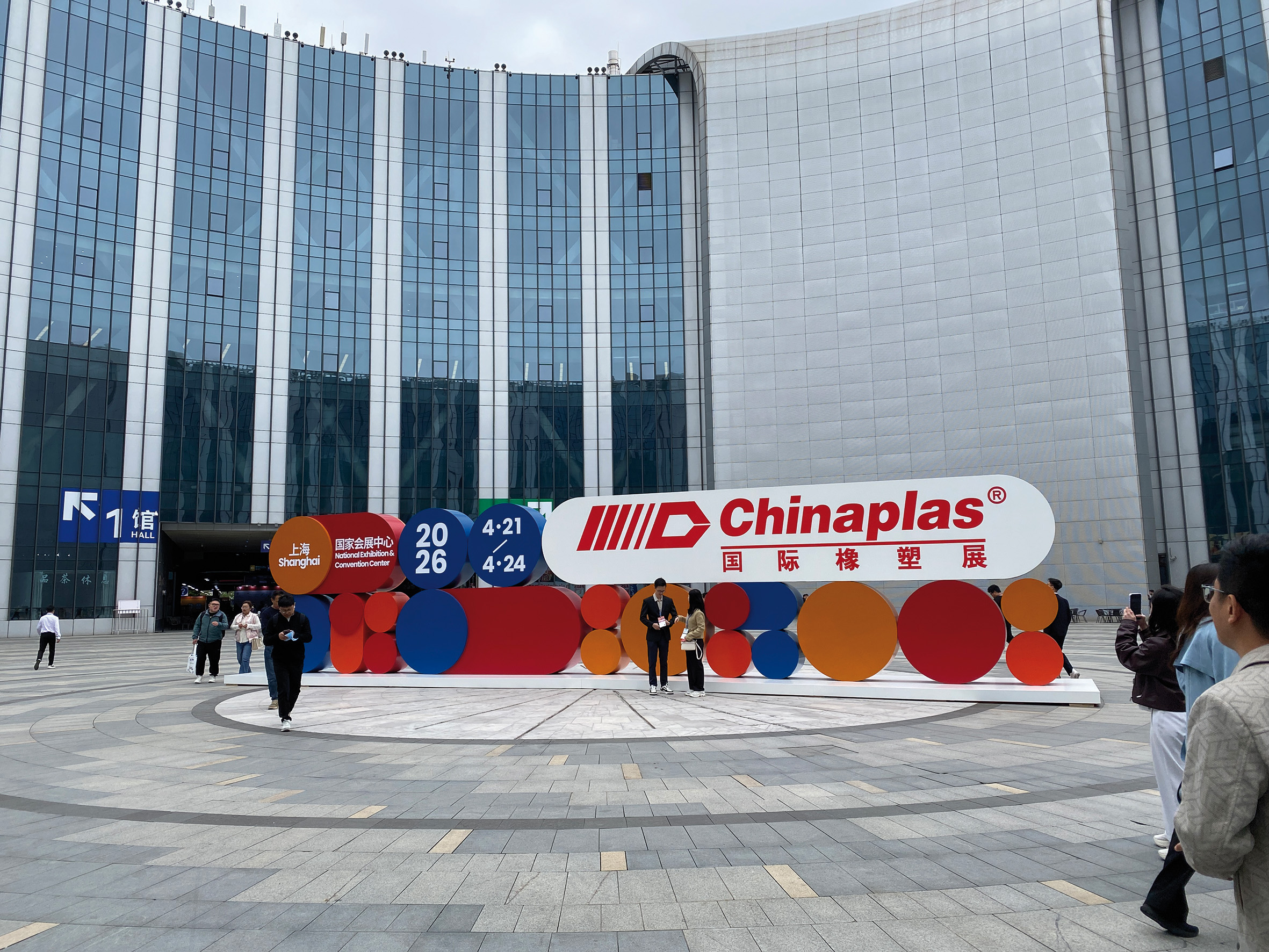
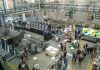
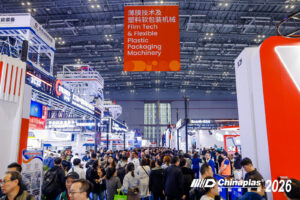
There is a moment, when entering CHINAPLAS for the first time, when you stop and look around. A brief sense of disorientation, followed by a very clear feeling: something important is happening here. Sixteen halls, 390,000 square meters occupying the National Exhibition and Convention Center in Hongqiao, over 5,000 exhibitors from 46 countries and regions, more than 3,800 machines running simultaneously. Numbers alone are not enough to convey the atmosphere, but they help to grasp its scale.
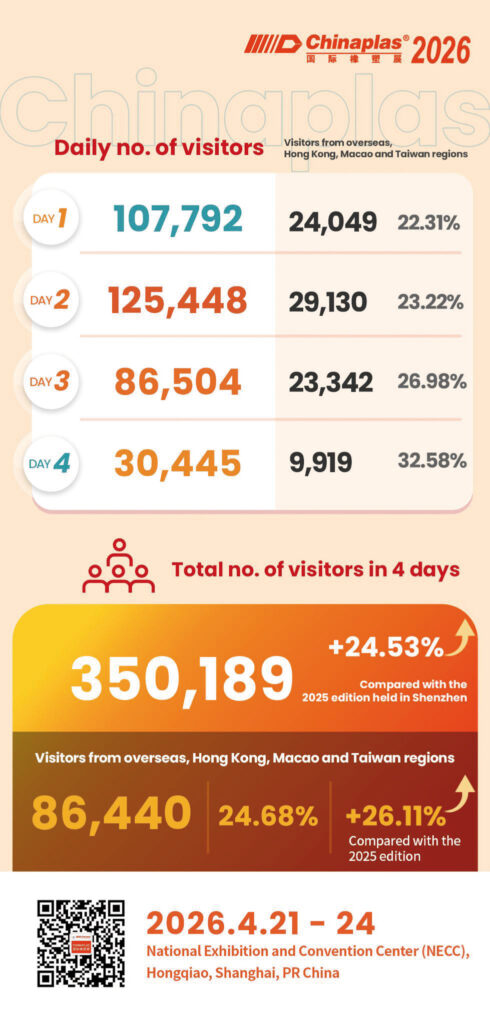
The 2026 edition, held from April 21 to 24, set a new record: 350,189 total visitors, a 24.53% increase compared to the previous edition held in Shenzhen. Of these, 86.440 came from overseas or from Hong Kong, Macao, and Taiwan, nearly one in four visitors, marking a 26.11% increase compared to 2025. What truly stands out is the meaning behind these numbers. It is not just about participation, but centrality. Shanghai fair confirms itself as one of the main global reference points for the plastics and rubber industry, capable of attracting operators from all over the world and representing a Chinese market that is no longer peripheral, but a key player.
Inside the fair: movement, speed, guidelines
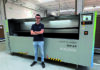
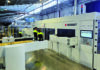
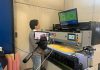
Stands are constantly lively, machines are running, demonstrations ongoing. It is a dynamic exhibition where the concept of display turns into direct experience. In this context, Chinese companies stand out for the speed at which they move, showing an extremely rapid ability to execute and adapt. The impression is of an industrial system that does not merely follow trends but absorbs and reworks them in a very short time.
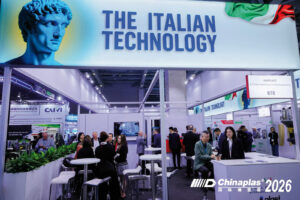
Alongside them, there is a significant presence of Italian and European companies, many of which already operate steadily in this market, evidence of an industrial dialogue that is now well established. Packaging, and flexible packaging in particular, is widely represented, with increasingly integrated solutions. The focus is no longer just on materials or machines, but on complete systems where automation, software, and sustainability interact.
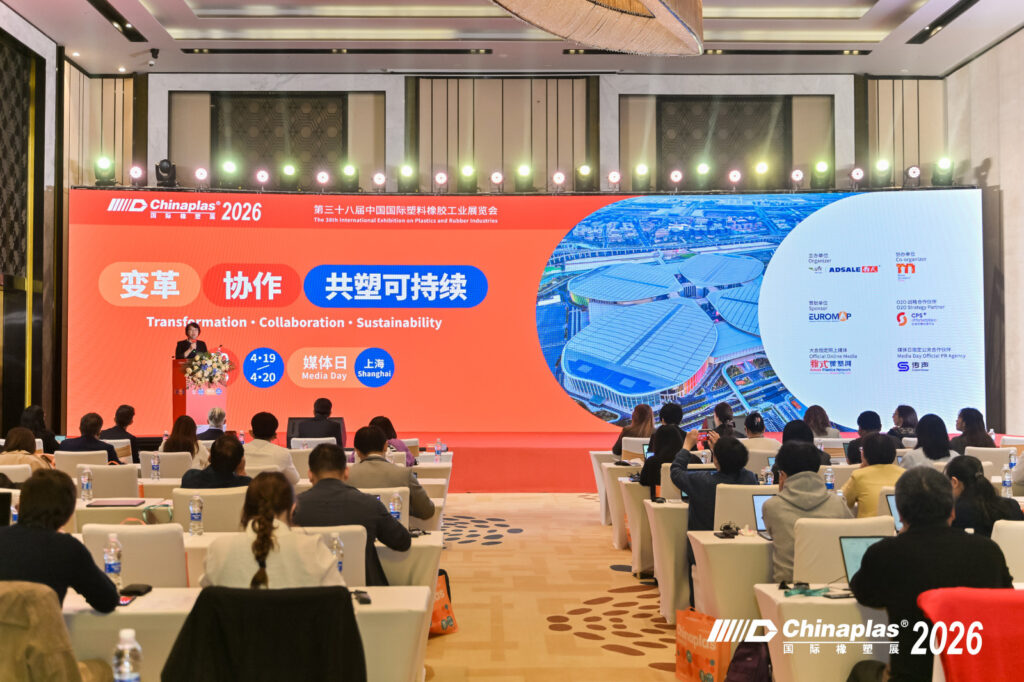
This evolution is also reflected in the themes that emerged during the Media Days. Helen Chan, General Manager, Marketing Communications of Adsale Group, clearly outlined the guidelines: sustainability, circularity, new materials, technology, and research. But walking through the stands, one senses something even deeper: the growing maturity of the Chinese industrial system.
The Chinese market: from observed to protagonist
Speaking with exhibitors, engaging with companies, and walking through the halls leads to a shared conclusion: the Chinese market can no longer be underestimated.
In recent years, the quality of products and solutions has grown significantly. The technological level has increased, as the ability to offer competitive alternatives, not only in terms of cost, but also performance. Certainly, differences still exist compared to European know-how, especially in terms of experience, market dynamics management, regulatory compliance, and after-sales services. And it is precisely here that an interesting space for partnerships emerges.
Many Chinese companies seek dialogue with Europe, not only for technological reasons, but also to better understand rules, standards, and business models. At the same time, however, they demonstrate an extremely fast learning capacity. The result is a constantly evolving balance: on one side the solidity and experience of Italy and Europe, on the other the speed and competitiveness of China.
Technology, automation and sustainability
This balance is also reflected on technological level. Robotics, automation, and digital systems are now widespread and transversal: they are no longer a distinguishing feature, but a consolidated foundation. Production lines are becoming increasingly intelligent and integrated, designed to be efficient, flexible, and scalable.
In this context, sustainability also takes on a more concrete dimension. No longer just statements, but real applications: innovative materials, recycling technologies, process optimization. This leads to a broader reflection. Plastic remains one of the most extraordinary and useful inventions of our time, but also one of the most controversial. The point is not to oversimplify the debate or take sides, but to rethink it. The direction is clear: innovation in materials, development of circular solutions, investment in research. It is on this ground that the sector is building a tangible response, transforming a critical issue into an opportunity for progress.
A flawless organization
Finally, what stood out was the overall organization. Managing an event of this scale is no small feat, yet everything felt smooth, structured, and efficient for us. From logistics to access, from flow management to space distribution, CHINAPLAS demonstrates a high level of organization, capable of supporting such a complex system without losing efficiency.
And perhaps this is the most interesting takeaway. CHINAPLAS is not just an exhibition event, but a space where ongoing changes in the global industry, and increasingly in the packaging world, are reflected. China is no longer a market to observe from a distance, but a central player, with its own pace and direction. It is a market that fascinates but also requires attention and study. At the same time, dialogue with Europe remains essential, in a balance that moves between competition and collaboration.
Because if there is one thing CHINAPLAS 2026 made clear, it is that the future is no longer something to wait for, but something that is already moving, fast. The next appointment is in April 2027, to see how far it will have gone.