



At its now customary annual event, now in its third year, RTS outlined the company’s strategic vision to over 100 customers and prospects, placing artificial intelligence and the importance of people in decision-making processes at the center of the debate, in an innovation journey built on experience, data security, and technological integration
Artificial intelligence at the service of decisions was the underlying theme of the conference organized by RTS on April 24th, in the splendid setting of Palazzo di Varignana in Castel San Pietro in the hills outside Bologna. The event brought together customers, partners, and industry professionals for a day of in-depth discussion on new digital transformation scenarios, thanks to a program packed with content, case studies, and concrete testimonials, confirming the growing interest in solutions capable of combining data, automation, and artificial intelligence, while always keeping people at the center.
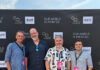
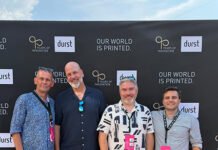
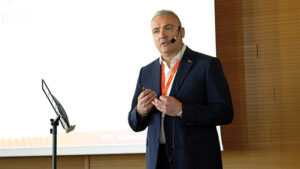 “Our vision is very clear: AI with humans. Artificial intelligence can process data at incredible speed, but it’s people who create insights, opportunities, and valuable decisions”, said Robertino Piazza, CEO of RTS, opening the event (here in the picture).
A particularly significant development concerned the journey undertaken by RTS, which this year celebrates 45 years of business and is now part of the international TSS group. Piazza then highlighted the work done internally by the company, where a specialized team of young, digitally native professionals has been created alongside experienced professionals. “We chose to bring together new generations and historical knowledge of the sector. It is from this mix that the most interesting results are emerging”.
Equally important was the reference to the issues of security and data management, central aspects of any digital transformation process. “When artificial intelligence is introduced, the first question everyone asks is: where does my data go? That’s why we immediately worked on solutions that guarantee protection, confidentiality, and full control of information”.
The opening speech clearly outlined the underlying theme of the entire day: demonstrating how innovation can translate into concrete tools capable of simplifying processes, enhancing corporate expertise, and supporting increasingly rapid and effective decisions. “Artificial intelligence is a frontier yet to be explored”, concluded Piazza. “But we want to do so methodically, expertly, and together with our clients”. This statement summed up the RTS approach: technological, pragmatic, and deeply focused on the value of relationships.
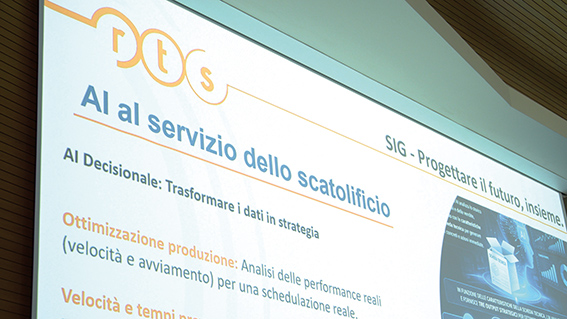
Prompting advantage: AI support for better thinking in the age of accelerated obsolescence
It was one of the most popular talks of the conference, sparking a profound reflection among the audience on the role of artificial intelligence not so much as an operational tool, but as a factor profoundly transforming our way of thinking.
Prof. Riccardo Silvi of the Department of Business Sciences at the University of Bologna explained how digital transformation and AI have drastically accelerated the obsolescence of skills, shifting the focus from simple “knowledge” to “knowing how to think”. However, its growing perceived reliability risks producing a significant side effect: the progressive delegation of human thought. The highlighted risk is that of “cognitive delegation,” where the use of AI leads to a reduction in critical thinking, not because people are incapable, but because they become accustomed to trusting the answers produced by machines. In this scenario, the danger is not the algorithm’s error itself, but the willingness to stop questioning it critically and in depth. The difference lies precisely in the user’s attitude: using AI to think better or to avoid thinking.
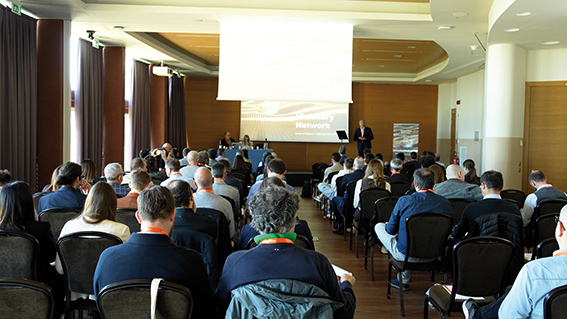
Through case studies such as Cartamatic and KTM, Silvi demonstrated how a superficial analysis based on seemingly solid data and generic prompts can lead to misleading assessments. Companies with positive indicators can hide structural weaknesses that emerge only by broadening the scope of analysis: quality of revenue, inventory dynamics, the economic cycle, the cost of money, and weak signals that are not immediately visible. The key point, the professor emphasized, is therefore not the quality of the artificial intelligence’s response, but the quality of the questions it is asked. Generic prompts generate generic, but potentially misleading, responses because they appear coherent.
Hence the necessary evolution of skills: no longer just technical analysis skills, but above all critical, systemic, and contextual thinking. Prompts themselves become a reasoning methodology, useful for exploring alternative scenarios, questioning implicit assumptions, and interpreting the connections between economic and market variables.
The partnership with RTS and future projects: Euroscatola and Ondulkart presented their exeriences
Two testimonials were presented by longtime RTS clients, who discussed the journey they have built together with the software house over the years.
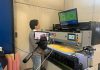
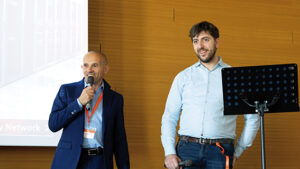 In the first presentation, Luca Diamante, Head of Supply Chain, and Luca Naccari, Head of IT, (here in the picture), discussed the digitalization journey of EuroScatola, a company with over 60 years of history, four plants, and approximately 180 employees, currently engaged in a process of growth and industrial integration supported by RTS. Three major projects developed with RTS were presented: Data Extractor, which automates order entry using AI, reducing processing times by up to 60%. Easy Setup optimizes the management of dies and printing plates across multiple plants, improving operational efficiency by 25-30%. Finally, the RTS Sales App, featuring artificial intelligence and an agent-based chatbot, is designed to ensure secure and immediate access to company data. Overall, Euroscatola’s experience highlights how digital integration across the supply chain is becoming a key factor in increasing efficiency, speed of decision-making, and control of production processes.
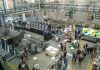
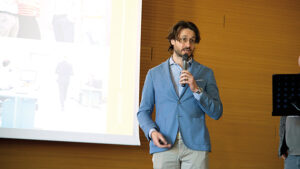 The second case study featured Riccardo Buoso, General Manager of Ondulkart, (here in the picture), and Stefano Zaratin, IT Manager, who presented the company’s evolution, currently in a crucial phase of industrial development and generational transition. Ondulkart is a family-run business with over 55 years of history, now in its third generation. The group operates four plants in Cessalto area (Treviso), with approximately 320 employees and around twenty production lines. In recent years, the company has launched a major investment and expansion plan, developing a new integrated production hub in collaboration with Progroup within a shared industrial area of over 150,000 m². The project represents a strategic evolution that combines production growth and physical and digital integration between the two entities. At the same time, Ondulkart continues to operate at its historic sites, maintaining traditional supply chain management.
In the Ondulkart system, information complexity is not a side effect but a structural component to be managed. The current model is based on a network of interfaces connecting internal systems, partner platforms, particularly Progroup, and logistics and automation solutions. At the heart of the architecture is the RTS system, which enables direct communication with suppliers, particularly for raw material management. On the commercial front, Ondulkart has integrated the Salesforce RTS systems and business intelligence tools such as Qlik, creating a continuous flow linking estimates, orders, and actuals. Commercial information is thus transformed into operational data synchronized throughout the entire supply chain.
Overall, the model described highlights a fully connected supply chain, in which the flow of information not only supports production but also becomes a guiding element. In this context, RTS takes on the role of a central data orchestration infrastructure, capable of coordinating suppliers, production, and the market in a single integrated ecosystem.
All the latest innovations presented by RTS
Of course, there was also space for the latest innovations implemented by RTS. Andrea Danielli, RTS R&D Manager, illustrated the evolution of RTS Hub, a platform designed to improve interfacing with third-party systems and facilitate dialogue between different software programs. The focus of the presentation was the value of integration, the intelligent management of document flows, and the growing role of Data Warehouse as an advanced information base for analytics and business intelligence.
Then, one of the most innovative projects of the day was discussed, with Domenico Marono, RTS Product Specialist, and Livio Zito, Project Manager, presenting K-Pilot, a system developed to enhance corporate knowledge through artificial intelligence. The goal is as simple as strategic: to provide every user with accurate, up-to-date, and immediately accessible information via advanced chatbots, reducing search times, inefficiencies, and loss of internal know-how.
Marco Trastu, RTS Product Manager, then demonstrated the evolution of corporate products with integrated Generative AI capabilities, confirming how artificial intelligence is gradually becoming part of the everyday tools used by businesses, with tangible benefits in terms of operational speed, automation, and decision-making support.
RTS partners’ opinion
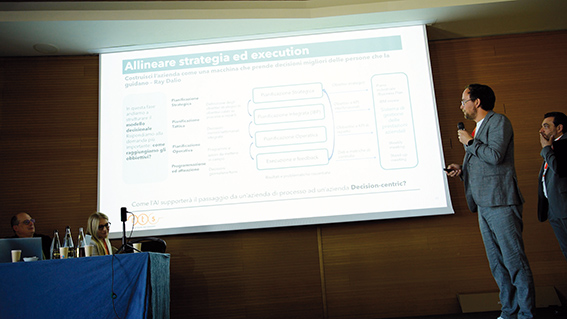
Among the highlights of managerial insight was Induvation’s presentation, with Jan Bredereck and Alberto Berri, dedicated to Integrated Business Planning and the role of AI in building increasingly accurate, timely, and dynamic decision-making scenarios.
On the operational front, Onit, with CEO Claudio Gambetti, presented the value of collaborating with RTS in reducing logistics inefficiencies and streamlining field processes, confirming how digital innovation can find immediate applications in everyday activities.
There was also an in-depth look at one of the most sensitive issues for companies today: cybersecurity. Paolo Rosetti, CEO of Consulenti Privacy, took stock of the NIS2 directive, illustrating the obligations, digital compliance, and governance needed to be ready to meet customer and market demands.
Robertino Piazza concluded the day, reiterating RTS’s commitment to accompany companies on a concrete path of innovation, combining technology, expertise, and industrial vision. The powerful message from the event was clear: artificial intelligence is no longer a topic of the future, but a tool already available today to build more efficient, integrated, and competitive businesses. “We’re not just observing the future”, he emphasized, “we’re trying to give it a concrete form, transforming ideas into operational solutions”, said Piazza.
A future that today is measured in increasingly rapid cycles, where transformations occur over the span of months, if not weeks. This speed makes it increasingly necessary to have a shared vision and tools capable of adapting as rapidly as the market. “We are all, in some ways, in the same boat in the coming years”, Piazza emphasized, emphasizing how market challenges increasingly require collaboration along the entire supply chain. The goal is not simply to adopt new technologies, but to build a shared growth path that allows companies to face change with greater awareness and strength.