






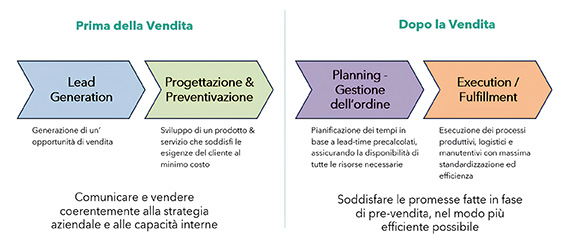
In previous articles, we analyzed the four macro-processes of corrugated packaging companies—from Lead Generation to Execution & Fulfilment—highlighting their logic and key challenges. Today, we introduce Integrated Business Planning (IBP), the process that connects these areas and overcomes the silo-based management still common across the industry.
IBP structurally coordinates the different business functions—sales, technical, production, and finance—integrating information and decision-making into a single process. Rather than replacing existing processes, it connects them, enabling box plants and converting companies to operate more efficiently and in a results-oriented way.
The industry is currently undergoing a major transformation, characterized by volatile demand, rising raw material costs, and increasing pressure on lead times and service levels. At the same time, customers expect greater customization and faster response. In this context, IBP is one of the most effective tools to maintain flexibility and support data-driven decision-making. For a box plant, it means moving from reactive order management to proactive management of demand, production capacity, and profitability.
Key phases of integrated planning in a box plant
To effectively apply this model, it is useful to structure the process into several key phases.
- Customer and market demand analysis

The planning process begins with an in-depth analysis of customers and market demand.
Customer Relationship Management (CRM) systems play a central role in this phase. They enable companies to monitor order history, purchasing behavior, seasonality, and development opportunities within existing accounts.
The analysis should not be limited to actual demand but must also include potential demand. This means assessing growth opportunities for each customer or market segment by considering market trends, new product introductions, and customers’ commercial strategies.
It is also essential to maintain continuously updated sales forecasts by integrating multiple sources of information, including historical data, sales input, customer development plans, market trends, and data from internal systems.
The goal is to build a realistic demand forecast shared between sales and top management.
A well-structured CRM also helps identify commercial priorities by distinguishing between strategic customers, growing accounts, and low-potential clients. In a box plant, where relationships with industrial customers are often long-term and direct, this analysis is crucial for anticipating demand and planning production capacity effectively.
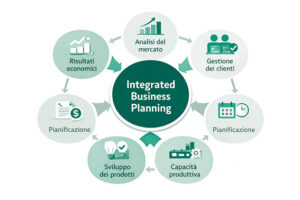
2. Production capacity analysis
Once demand has been estimated, it is necessary to verify whether the company has sufficient production capacity to meet it, by analyzing equipment, resources, and overall system efficiency.
In a box plant, this includes evaluating key elements such as corrugator capacity, converting lines, setup and changeover times, plant saturation, workforce availability, and logistics.
Manufacturing Execution Systems (MES) are increasingly essential in this phase, enabling real-time monitoring of production. They provide data on operating times, machine downtime, production speed, and efficiency.
These insights allow companies to understand their actual production capacity and identify bottlenecks within the system.
Another key aspect is the development of improvement scenarios through methodologies such as Lean Manufacturing and Total Productive Maintenance (TPM), which help reduce waste and increase equipment reliability.
This integrated approach allows management to determine whether forecast demand can be met with existing resources or whether corrective actions are needed, such as process optimization, additional shifts, or new investments.
The adoption of Advanced Planning & Scheduling (APS) systems represents a further step forward. These tools enable companies to simulate operational scenarios—such as demand increases, shorter lead times, or efficiency improvements—and assess their impact on capacity, workload, and delivery performance.
3. Product portfolio analysis
A fundamental step in IBP is the analysis of the product portfolio. Corrugated packaging companies often manage hundreds or even thousands of SKUs, but not all contribute equally to profitability or efficient capacity utilization.
This analysis helps identify which products generate the most value and which have lower margins or higher production complexity. Key factors include product profitability, manufacturing complexity, volumes by customer or market, and the impact of production and raw material costs.
This makes it possible to distinguish high-value products from those that consume capacity without creating sufficient value or that are not well aligned with available equipment.
The involvement of the technical department is essential in this phase, as it plays a key role in developing and optimizing packaging solutions.
Close collaboration between technical, sales, and production teams enables the development of innovative solutions that meet customer needs while remaining efficient from an industrial perspective.
4. Plan Integration and variance analysis
Plan integration is the core of the IBP process. In this phase, all elements analyzed previously are aligned and consolidated.
This includes integrating the demand plan, customer service levels, production capacity plans, and financial plans.
The objective is to verify whether operational decisions are consistent with the company’s strategic goals.
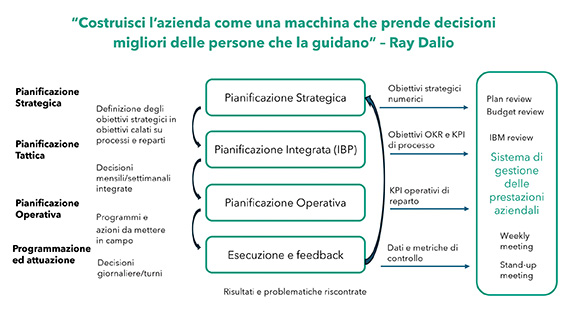
This analysis often highlights gaps between forecasts and targets — for example, when demand exceeds available capacity or when the product mix does not ensure the desired profitability.
In such cases, companies must evaluate alternative scenarios, such as increasing capacity, improving efficiency, adjusting the product mix, or revising commercial strategies.
Business Intelligence systems play a crucial role here by providing structured, reliable, and shared data, enabling a consistent view of performance and supporting informed decision-making.
 5. Executive decision-making meeting
The final phase is the executive decision-making meeting, during which management reviews the results of the previous analyses and defines the final decisions.
Participants typically include general management, sales, operations, supply chain, controlling, and other key functions. During the meeting, both operational and financial KPIs are reviewed.
Management defines strategic decisions that will guide the company in the coming months, alongside increasingly important tactical decisions needed to respond quickly to market changes—such as fluctuations in energy and raw material costs.
Typical actions include revising sales plans, redefining production priorities, launching efficiency initiatives, and developing new packaging solutions.
This phase ensures alignment between operational decisions, corporate strategy, and financial objectives. At the end of the meeting, the integrated plan is finalized and becomes the reference for execution.
In this way, planning becomes a concrete management tool. Recent examples include adapting contracts to raw material cost increases, expanding warehouse capacity to improve service levels, and standardizing production parameters to enhance efficiency.

The growing role of AI and data analytics
In the coming years, artificial intelligence (AI) and advanced data analytics will have an increasingly significant impact on business planning.
Corrugated packaging companies generate large volumes of data every day—from customer orders to production performance and machine data—which, if properly leveraged, become a strategic asset.
AI enables companies to transform this data into actionable insights, improving demand forecasting, identifying market trends, simulating production scenarios, and detecting inefficiencies.
Advanced analytics tools provide real-time visibility, allowing managers to make faster and more effective decisions. For example, systems can immediately detect anomalies in customer orders or drops in production performance, enabling timely interventions.
Looking ahead, the integration of AI into planning processes will become increasingly widespread across the industry.
Conclusion

The paper and corrugated packaging industry is undergoing a profound transformation, with more dynamic markets and increasing pressure on costs, service, flexibility, and sustainability.
In this environment, structured and proactive planning is a key competitive factor.
Integrated Business Planning enables companies to connect market dynamics, customer management, production capacity, product development, and financial performance within a single, coherent framework.
For box plants, this translates into better alignment between demand and capacity, improved asset utilization, and a stronger focus on high-value products and opportunities.
Digital technologies and data analytics play an increasingly central role, enabling faster and more accurate decisions. The integration of AI will further enhance forecasting capabilities.
Looking ahead, companies that successfully integrate planning, data, and continuous improvement will gain a decisive competitive advantage. IBP is not just an operational tool—it is a strategic lever for sustainable, long-term growth, where the ability to turn data into decisions will be a critical success factor.