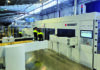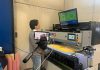



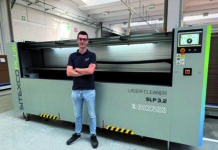
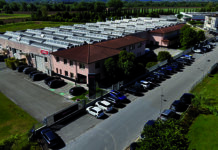
Ghelfi Ondulati has chosen to invest in Sitexco Plus technology, distributed exclusively in Italy by Simonazzi, for cleaning its anilox rollers. This installation stands out not only for its innovative technology but also for its scale: it is the first machine installed in Italy capable of cleaning rollers with a width of up to 3.2 meters
In flexo printing, process quality and consistency depend on a component that is often less visible but fundamental: the anilox roller. Proper cleaning of the cells is essential to maintain ink transfer characteristics over time and ensure the repeatability of the printing process.
Traditionally, anilox cleaning can be performed using various technologies, including chemical solutions, bicarbonate systems, and ultrasonic cleaning. Laser technology offers a different approach, as it allows the direct removal of residues within the cells without the use of chemicals.
However, speaking generally of “laser cleaning” does not necessarily mean referring to the same technology. A distinctive feature of Sitexco solution is its galvanometric laser beam scanning system, a technology in which the company has built up specialized expertise.
A controlled laser, not just powerful
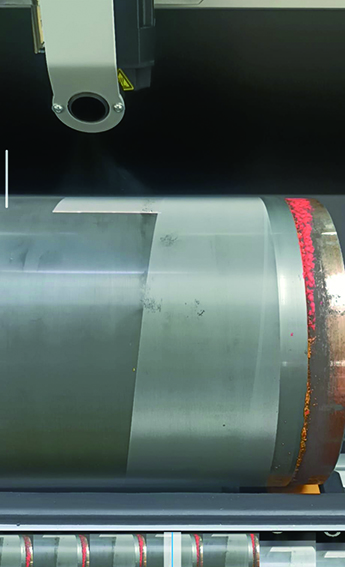
Energy control is precisely what makes Sitexco Plus technology so technically interesting. This globally patented system was developed to clean cells in a single pass, avoiding beam overlap on the anilox surface. Consequently, only the energy required for the cleaning process is applied, minimizing the impact on the surface. “It is not simply a matter of having a more powerful laser”, explains Nicolò Albani of Simonazzi, “but of being able to control the energy and apply it exactly where needed, in the precise amount required”. This is a particularly important approach, given that anilox rollers can vary significantly in terms of screen ruling, cell volume, the type of ink or coating used, and the number of residues to be removed. For this reason, the Sitexco Plus employs cleaning programs tailored to the specific characteristics of the anilox roller and the material to remove.
The goal is to achieve effective, deep cleaning without subjecting the cylinder to excessive energy, thereby preserving its properties over time. The software interface reflects this philosophy, offering simple operation and automatic monitoring of key anilox data.
Productivity is another distinguishing feature. For an anilox roller measuring approximately 2.10 meters, a single pass takes roughly 20–25 minutes, while the machine installed at Ghelfi Ondulati can handle rollers up to 3.2 meters long. For shorter cylinders, multiple units can be processed simultaneously, maximizing the machine’s capacity.
Special attention has also been paid to residue management. Material removed during cleaning is vacuumed up and converted into ash, eliminating the need for bicarbonate, liquids, or chemical agents.
“But the real challenge”, Albani points out, “was balancing deep cleaning with the preservation of the anilox roller. Tests conducted with Ghelfi confirmed that it is possible to effectively remove residue from the cells without compromising the cylinder’s integrity or its ink-transfer characteristics.
That is the key point: a controlled laser, not simply a powerful one. The technology must allow for deep cleaning, but always using the precise amount of energy required”, concludes Albani.
Ghelfi Ondulati: a choice driven by production needs
 It is against this technological backdrop that Ghelfi Ondulati made its decision, identifying the Sitexco Plus solution as the answer to its anilox cleaning requirements. The installation was carried out in collaboration with Simonazzi Srl, the exclusive Italian distributor for Sitexco technologies, which supported Ghelfi throughout the evaluation and implementation process.
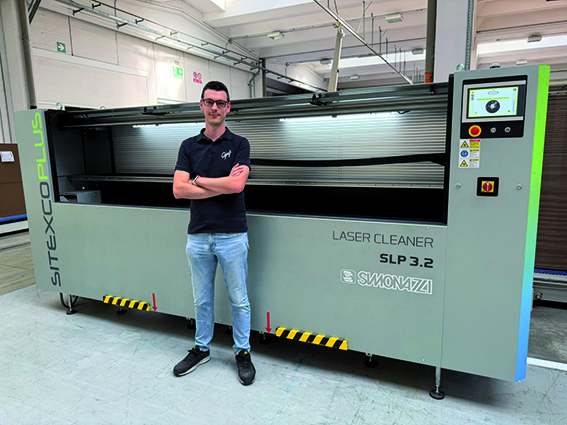
A particularly significant aspect of the investment is the machine’s capacity. The installed unit belongs to the Sitexco Plus SLP3.2 range, featuring a cleaning width of 3,200 mm. This is a particularly attractive feature for a company that handles large-format anilox rollers, making this installation a benchmark for the Italian market; indeed, project data indicate that this is the first machine installed in Italy with such a wide cleaning capacity.
However, the choice of this type of technology goes beyond mere cleaning quality. The investment also addresses economic, organizational, and environmental factors, ranging from the elimination of chemicals and a reduction in consumables to the ability to make the process more standardized and traceable.
Face to face with Matteo Casti, production manager at Ghelfi Ondulati
What needs led you to seek a new anilox cleaning solution, and why did you choose Sitexco Plus technology?
“The decision stemmed primarily from the need to overcome certain limitations of the bicarbonate-based technology we were previously using. There were various issues associated with bicarbonate, from purchasing consumables to disposal, and the maintenance of the machine and anilox rollers. Furthermore the cleaning results were satisfactory, but they weren’t really optimal for us. We had previously used laser technology from another manufacturer but harbored doubts, which ultimately proved well-founded, about its potential impact on the anilox surface. However, about eight years had passed, and we felt it was time to re-evaluate this technology. We analyzed the various solutions available on the market, and at the end of our assessment process, the one proposed by Simonazzi stood out as the highest-performing option that best met our needs”.
How was the machine startup, and how important was Simonazzi’s support?
“The startup went very smoothly. Compared to the average machinery we use, this is a relatively simple solution, practically plug-and-play. Once it was positioned, only minimal training and setup by the technicians were required to get it up and running”.
After the first few months of use, what concrete results have you observed?
“The cleaning quality is certainly superior to what we achieved with bicarbonate. We have already performed many cleanings over these first two months, partly because, knowing the new machine was on its way, we had extended the service life of some anilox rollers and consequently found ourselves with a significant number of cylinders requiring treatment. The results are truly impressive: visually, the rollers look almost brand new. However, the most significant benefit lies in the impact on the printing process itself, as a properly cleaned anilox ensures more consistent ink transfer over time. We were able to verify this firsthand during the installation. An anilox roller that we believed was destined for refurbishment was cleaned several times and then put back into the press; the resulting print quality was perfectly satisfactory. This example shows how much cleaning quality can influence both the service life of anilox rollers and overall printing performance”.
So, the benefit isn’t just about the cleaning itself, but also the quality of the printing process?
“Exactly. If the anilox roller stays consistently clean, ink transfer becomes more stable, too. This means less color variation, greater quality consistency, and fewer issues during startups. There’s another aspect, too: the machine’s simplicity encourages the printer operator to actually use it. They simply load the anilox, start the cycle, and don’t have to worry about bicarbonate, filters, consumables, or the dust generated during cleaning. It represents a significant change in day-to-day operations”.
Have you already assessed the return on investment?
“We haven’t calculated a specific ROI based solely on the machine’s cost, because for us, switching to this technology was primarily a
production necessity. However, the return needs to be evaluated by considering a combination of factors. If you look only at the purchase and disposal of bicarbonate, the payback period would likely be very long and wouldn’t do justice to the investment’s true value. You also have to consider the quality the machine delivers: more consistent ink transfer, reduced waste, faster startups, and the ability to avoid quality-related complaints. For a company with the size of Ghelfi and taking all these elements into account, we believe an investment like this can pay for itself within about twelve months”.
Finally, how much weight do sustainability and safety considerations carry in the decision?
“These are important aspects. Eliminating bicarbonate means, first and foremost, eliminating the management of consumables and the associated materials that must be purchased and disposed of, while also making the cleaning process much simpler from an operational standpoint. But for us, sustainability and efficiency go hand in hand. A technology that ensures cleaner, more consistent anilox rolls also means greater printing process stability, reduced waste, and better utilization of the rolls throughout their service life. It is, therefore, a benefit that extends well beyond the cleaning phase itself”.
Ghelfi Ondulati’s decision aligns with an increasingly evident trend in the printing industry: the pursuit of technologies capable of simultaneously improving quality, efficiency, and sustainability. In the context of anilox cleaning, the shift from chemical methods to laser technology is not merely a matter of swapping one technology for another. It involves rethinking the process by prioritizing precision, control, and repeatability, eliminating consumables and waste residues, and at the same time seeking a rapid ROI.