





Today, sustainability in the packaging sector is widely debated and central to every decision-making process. We talk about bioplastics, compostability, recyclability, and CO₂ reduction. But the real difference today is not made by those who simply claim to be sustainable. It is made by those who redesign products starting from their end-of-life
BIO-PRO® is an Italian company established in 2014 following the patent, together with University of Bologna, of a hybrid thermo-chemical biological process capable of converting cellulosic waste into bioplastic (PHA) and energy. The company’s payoff, “We renew matter”, encapsulates its mission to rethink the entire packaging life cycle for a more sustainable future, starting from the concept of end-of-life as a key design element.
BIO-PRO®’s strength points
One of the defining features of BIO-PRO® is its three-dimensional identity. The company does not simply offer a compostable film, but integrates material development with process engineering thanks to the synergy with Synergic Solution, an affiliated company specializing in logistics consulting and distributor of software for packaging design. Synergic Solution has deep expertise in converting processes of flexible and paper-based packaging.
In a sector where raw material formulators often do not communicate with converters, BIO-PRO® chooses to connect the dots: formulation, machinability, printability, sealing, mechanical performance, and distribution are addressed as parts of a single system. The result is a design-driven approach that views packaging not merely as a support, but as an industrial ecosystem.
“While the market standard for compostable films for flag labels ranges between 230 and 350 microns, BIO-PRO® technology offers the same performance at just 120 microns, with raw material savings exceeding 50%”, explains Claudio Giacomelli, CEO of the company. “We are talking about a compostable monomaterial that can be disposed of in organic waste collection in accordance with ISO EN 13432”.
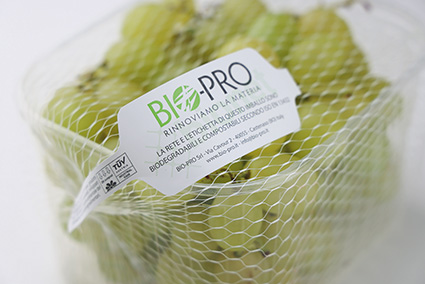
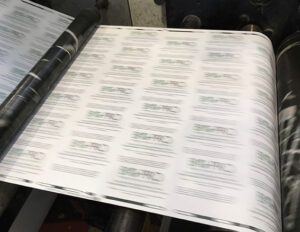
BIO-151119* has also been designed to be compatible with the most common printing and packaging techniques. It can be printed in UV flexo, solvent-based flexo, and digital printing, since it has been tested on HP Indigo machines. Sealing can be carried out either by heat or ultrasound, an essential feature for lamination with the tubular net BIONET®, also developed by BIO-PRO®, enabling the elimination of adhesives and metal clips in fruit, vegetable, or seafood packaging.
The example of nursery tags clearly illustrates the company’s philosophy. The material must withstand extreme thermal cycles: refrigerated storage with 90% humidity, summer exposure in fields, continuous handling. The film maintains integrity and legibility until the end of its life.
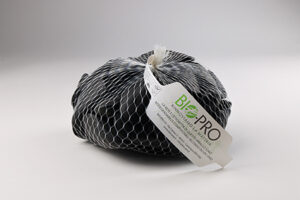 Compostable, yet designed to last, also ideal for paper applications
One common misconception about bioplastics is their presumed fragility. BIO-151119, however, is designed to perform in real-world conditions: it maintains its mechanical properties between +2°C and +40°C and resists high-humidity environments. Compostability does not compromise industrial functionality. This is a key point for a market that cannot afford line slowdowns or production inefficiencies.
BIOBOX is the commercial name of BIO-151119 application when used in paper converting, laminated with solid board or microflute cardboard. Thanks to its mechanical properties, it provides exceptional tear resistance, allowing a reduction in cardboard grammage and thickness. Since the film accounts for less than 5% of the total weight, the finished packaging can be entirely disposed of in the paper stream. The material also offers a pleasant tactile feel, a milky white color, a matte finish, and is odorless.
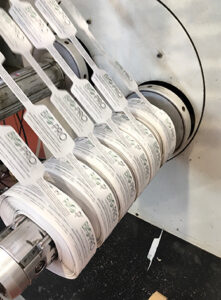
BIO-151119 biofilm is also suitable for food contact, making it ideal for flexible packaging applications such as frozen foods, given its resistance to low temperatures, as well as for luxury shopping bags.
“We know that greenwashing is always around the corner, even if the situation has improved compared to a few years ago”, says Giacomelli. “For this reason, we operate only in advanced markets where efficient waste management consortia are present, capable of enhancing by-products or generating secondary raw materials. We are critical of systems that send separately collected waste to incinerators, effectively nullifying all the valuable upstream work in the supply chain”.
 Beyond greenwashing: designed sustainability
At a time when European packaging regulations are pushing toward more responsible models, the concept of “Design for Disposal” is becoming central. Designing with end-of-life in mind is no longer just an ethical choice, it is a competitive necessity.
What emerges from BIO-PRO®’s journey is a shift in perspective. It is not about replacing one material with another, but about rethinking the balance between material, process, and finished product. In a market called upon to reduce consumption, thickness, and environmental impact without sacrificing performance and brand identity, the real challenge is industrial before it is communicative.
And perhaps the most credible sustainability is precisely the one that does not merely claim to be green, but demonstrates, micron by micron, that it uses less material to achieve the same result.
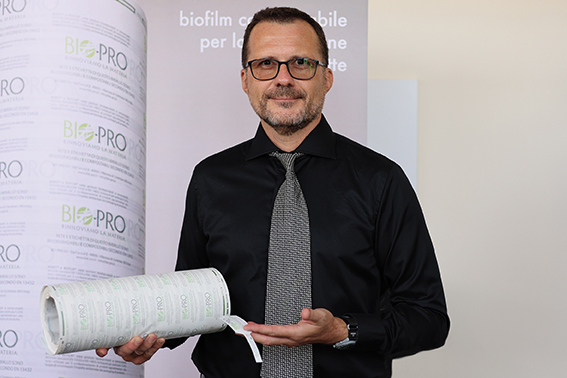
Face to face with Claudio Giacomelli, CEO of BIO-PRO®
If you had to summarize in one sentence the challenge BIO-PRO® aims to win over the next ten years, what would it be?
“Our challenge is not simply to replace plastic, but to renew both matter and the very culture of consumption, transforming ‘end-of-life’ from an ecological problem into a productive resource, in order to deliver a better world to future generations”.
Do you think the market is truly ready for renewal, or will it still require a regulatory or cultural shock?
“The large-scale retail and major brand owners are often more reactive and ready than legislators, but a cultural and regulatory shock is still necessary. According to our sources, packaging is often unfairly demonized: the real culprit is not the packaging itself, but the system’s inability to manage its collection and recovery. Paradoxically, 80% of separately collected plastic still ends up in waste-to-energy plants (incinerated) because it is too costly or difficult to recycle. True renewal will occur only when regulations enforce absolute coherence in disposal, banning products that force users to de-laminate different materials”.
In a sector often dominated by cost and margin logic, why investing in structural sustainability, not just superficial sustainability, the right choice?
“Because structural sustainability, when implemented with our approach, generates economic efficiency, not just ethical value. Investing in superficial solutions (greenwashing) is a pure cost. By contrast, our model demonstrates that ‘ecology is economy’ through the principle of reduction (‘Less is More’):
– Raw material reduction: using our BIO-151119 biofilm to produce 120-micron labels instead of the market standard (230–350 microns) halves raw material purchasing at the source.
– Material versatility: BIO-151119’s formulation enables multiple applications, from flexible packaging for frozen products to laminated solid board solutions for paper converting.
– Logistics optimization: thanks to our partner Synergic Solution, we help clients RETHINK packaging. Sometimes reducing thickness or redesigning packaging by just one millimeter allows more units per pallet, lowering transport costs. Innovation reduces costs, increases margins, and generates competitive advantage”.
Addressing brand owners and large-scale retail decision-makers directly, what would you ask of them today to truly accelerate the transition toward more responsible packaging?
“I would ask them to have the courage to demand simplicity for the end user. Stop asking consumers to act as waste engineers by disassembling packaging. The technology to avoid this already exists, and we provide it. Adopt monomaterial solutions or ultrasonic sealing to eliminate adhesives and metal clips. Ensure that the label shares the same destiny as the container: if the bag is bio-based, the label must be bio-based and everything should go into organic waste. Do not work in closed departments. Exploit our ‘tailor-made’ approach that combines technology, material science, and logistics. Accelerating the transition means removing the excuse of human error by designing packaging directly for its end-of-life”.