










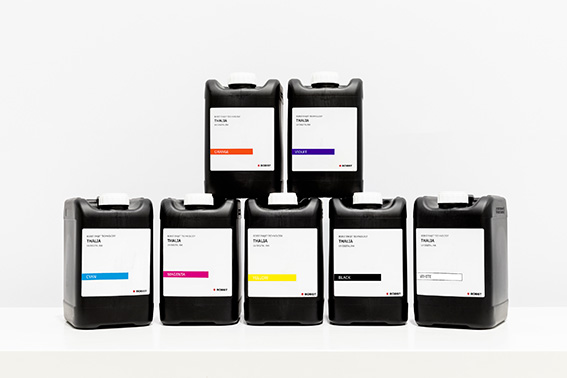
BOBST is strengthening its support for digital label printers by helping converters navigate increasingly complex compliance challenges through its Thalia UV Digital Inks, specifically formulated in line with upcoming European regulations.
As regulatory requirements for food, pharmaceutical, cosmetic, and toy packaging become more stringent across Europe, label converters are facing growing pressure to manage compliance risks, satisfy brand-owner audits, and make technology investments that remain viable in the long term.
With the Swiss Ordinance 2026 and the upcoming German Ink Ordinance (GIO) 2027 rapidly approaching, regulatory compliance is no longer considered a one-time requirement, but rather an ongoing operational discipline. In response, BOBST has reinforced its position in the digital label printing market with Thalia UV Digital Inks for labels, developed to help converters comply with increasingly demanding regulations without compromising print quality or production performance.
Designed for continuous compliance
 Thalia UV Digital Inks are TPO-free inkjet inks uniquely formulated to exclude more than 20 groups of substances of concern, including PFAS, phthalates, bisphenols, ITX, MOSH/MOAH, parabens, and primary aromatic amines.
This formulation strategy aligns the Thalia ink set with key industry regulations such as the Swiss Ordinance 2026 and the future German Ink Ordinance 2027, enabling converters to proactively prepare for future regulatory enforcement rather than react once regulations come into force.
High performance for demanding label applications
Thalia is a high-performance UV ink system specifically engineered for digital label printing using BOBST inkjet technology. The inks are suitable for a wide range of demanding applications, including food, cosmetics, and toy labels.
The ink set delivers consistent color reproduction over long print runs at speeds of up to 100 m/min and resolutions of 1200 × 1200 dpi. It also supports wet-on-wet printing, enabling a wide color gamut and accurate spot-color reproduction.
Existing BOBST press users can switch to the new compliant inks without requiring hardware upgrades or inert gas systems. In addition, most substrates do not require the use of primers.
These performance levels are achieved while maintaining controlled migration levels, allowing label converters to comply with the latest regulations without sacrificing productivity or print quality.
Compliance supported by structured governance
 First introduced at drupa 2024, Thalia UV Digital Inks were formulated using the authorized substances list defined by the Swiss Ordinance 2026. This forward-looking approach provides converters with a solution already aligned with future regulatory requirements, reducing the risk of operational disruptions or costly future adaptations.
Beyond ink formulation itself, BOBST has also implemented a dedicated Food Contact Material (FCM) governance framework designed to support converters in managing compliance. The framework combines authorized-substance formulations, certified migration testing, and predictive modeling to establish a structured and transparent compliance methodology.
As a result, converters benefit from a clearly defined migration operating window, enabling improved risk management and greater transparency. Thalia inks support compliance with major regulatory and industry frameworks including EU 1935/2004, EuPIA Good Manufacturing Practice guidelines, REACH, and leading brand-owner requirements.
Turning compliance into competitive advantage
Patrick Graber, Marketing Director PL Labels at BOBST, explained that Thalia UV Digital Inks have been developed specifically to address the growing compliance pressures facing digital label printers.
According to Graber, the introduction of the Swiss Ordinance 2026 and the forthcoming German Ink Ordinance 2027 is reshaping industry expectations around ink formulation, migration behavior, and documentation requirements. Brand owners are placing increasing emphasis on risk mitigation, traceability, and verifiable compliance data.
“Converters are no longer simply asked to comply, but to demonstrate compliance with robust, evidence-based data across every application,” he stated. “This effectively turns compliance into a continuous operational discipline, placing significant pressure on converters.”

This transformation is being driven not only by legislation, but also by brand owners demanding greater transparency and accountability throughout the supply chain. Consequently, inks have become one of the most heavily scrutinized components in label production.
Graber also highlighted BOBST’s active participation in the Joint Industry Group (JIG), which contributes to the development of guidelines linked to Article 35a of the Swiss Ordinance. This involvement has enabled BOBST to develop a forward-looking compliance strategy and integrate regulatory requirements directly into the formulation and development process.
According to the company, this approach allows converters to transform regulatory complexity into a source of competitive advantage, while also opening opportunities to secure new business from brand owners with particularly strict compliance requirements.
By combining regulatory compliance, print performance, and operational efficiency, Thalia UV Digital Inks provide label converters with a future-ready platform for sustainable growth while simplifying digital label production.