








In recent years, the flexible packaging industry has operated within a global context defined by increasing geopolitical instability, energy volatility, and supply chain tensions. Variables that seemed marginal to daily operational decisions only a few years ago are now directly influencing the competitiveness of converters
Recent conflicts in the Middle East represent another pressure factor on a system already marked by fluctuations in energy and raw material markets. For the printing and converting sector, these dynamics translate into unpredictable variations in the cost and availability of essential solvents for production processes, including ethyl acetate, ethanol, and isopropyl alcohol.
According to various market analyses, global solvent consumption in the flexible packaging sector exceeds 6 million tonnes per year, with demand driven particularly by Asia and the growth of food packaging. In this context, the volatility of solvent prices; closely linked to energy costs and petrochemical dynamics; represents an increasingly critical variable for industrial planning.
Parallel to geopolitical tensions in raw material markets, the European regulatory framework is also evolving rapidly. The update of the Industrial Emissions Directive (IED 2010/75/EU) and the evolution of the BAT Conclusions (2020/2009) for processes using organic solvents are introducing increasingly stringent environmental requirements for numerous industrial sites.
In this scenario, solvent management stops being an exclusively technical or environmental issue and takes on strategic value. Reducing dependence on external supplies and market fluctuations, while simultaneously improving the environmental performance of plants, becomes an essential lever to ensure operational continuity, cost stability, and greater industrial resilience.
VOC emission control technologies based on solvent recovery and regeneration are acquiring an increasingly central role in the industrial strategies of advanced converters. Transforming an inevitable process consumption into a circular resource within the facility allows a reduction in the environmental impact of processing, strengthens production autonomy, and decreases the exposure of companies to turbulence in energy and raw material markets.

We discussed these topics with Andrea Formigoni, CEO of DEC (Dynamic Environmental Corporation S.p.A.), to understand how current geopolitical and regulatory dynamics are influencing the solvent market and what contribution recovery technologies can offer in strengthening the competitiveness and sustainability of the sector. In this scenario, solvent management no longer represents only an environmental matter, but becomes a true strategic factor of industrial competitiveness.
Recent conflicts in the Middle East are destabilizing supply chains. What repercussions are you observing on the prices of solvents used in converting?
“Geopolitical tensions affect energy costs and global maritime logistics first, with direct effects on the petrochemical supply chain from which many industrial solvents derive. Products widely used in converting, such as ethyl acetate, ethanol, or isopropanol, can undergo significant fluctuations linked to both the cost of raw materials and international transport dynamics. For converters, this translates into greater difficulty in planning operating costs and managing stocks. In the absence of direct control over solvent availability, dependence on the external market becomes an increasingly relevant industrial risk factor.”
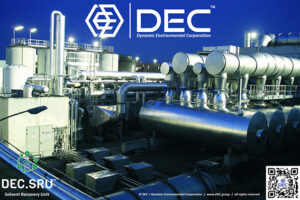
In this scenario of uncertainty, how can DEC SRU™ technology contribute to supporting flexible packaging producers?
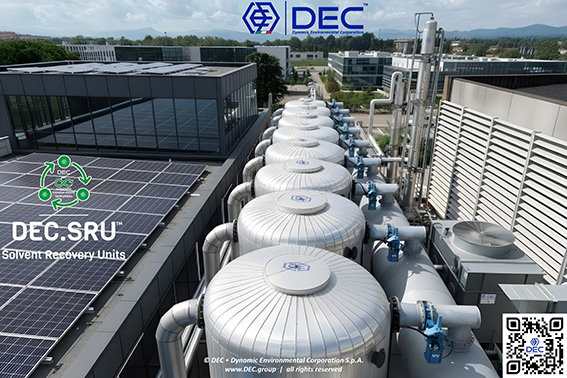
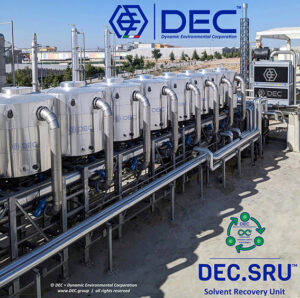
“DEC SRU™ (Solvent Recovery Unit) technology allows the recovery and regeneration of solvent coming from printing and lamination processes, making it suitable again for direct reuse in production cycles. In this way, a raw material normally destined for thermal destruction is reintegrated into the industrial process as a circular resource. Beyond the environmental benefits, this model significantly reduces dependence on virgin solvent procurement and mitigates the exposure of companies to fluctuations in energy and petrochemical markets. In a context characterized by high price volatility and global logistical tensions, solvent recovery becomes a concrete tool for operational cost stabilization and industrial resilience.”
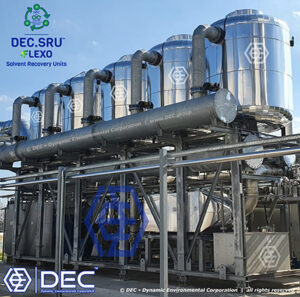
In the past, solvent recovery plants were mainly common in rotogravure. Today, many lamination and flexo companies are also adopting these technologies. What has changed?
“Historically, solvent recovery plants were installed mainly in rotogravure facilities or in solvent based lamination lines, where higher consumption justified larger scale investments. In recent years, technological evolution has made it possible to develop modular and scalable solutions, such as those based on the SMS™ (Smart Modular System) platform, which allow the application of solvent recovery even to more flexible production contexts with lower consumption volumes. The DEC SRU-Lam™ and DEC SRU-Flexo™ series were developed specifically for this purpose; adapting recovery technologies to the operational needs of the lamination and flexographic printing segments through systems that are more compact, modular, and easily integrated into existing lines.”
There is much talk about sustainability. How much does solvent circularity actually affect industrial competitiveness?
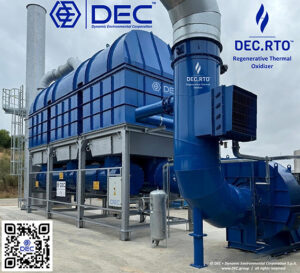
“Sustainability today is increasingly closely linked to economic efficiency. The production, transport, and thermal destruction of solvents; for example, through Regenerative Thermal Oxidation systems (RTO); represent a significant portion of indirect emissions associated with industrial processes.
In the case of solvents widely used in converting, such as ethyl acetate, life cycle assessments (LCA) indicate that the total footprint can reach approximately 7 kg of CO₂ equivalent for every kilogram of solvent, considering the entire production, logistics, auxiliary fuel, and thermal oxidation cycle. The recovery and regeneration of the solvent allow for a significant reduction in both the consumption of virgin raw materials and the emissions associated with its life cycle. However, the benefit is not only environmental; solvent circularity allows for the stabilization of operating costs and reduces the exposure of companies to oscillations in energy and petrochemical markets. For many converting companies, this translates into a concrete competitive advantage, as well as a measurable improvement in their ESG profile.”
European environmental regulations are becoming increasingly stringent. With the evolution of the Industrial Emissions Directive (IED) and the new guidelines on Best Available Techniques, many plants will have to adapt to stricter emission limits. Can this scenario also represent an opportunity to rethink the approach to solvent management?
“The evolution of the European regulatory framework, particularly with the Industrial Emissions Directive (IED 2010/75/EU) and the subsequent updates of the BAT Conclusions for the Surface Treatment sector (STS), is pushing many companies to reconsider their emission management strategies. Thanks to the development of increasingly compact, efficient, and simple to manage plants, a complementary approach based on solvent recovery and regeneration has emerged in recent years. SRU (Solvent Recovery Unit) units allow the treatment of emissions containing solvents in compliance with regulatory requirements, while recovering the solvent and reintegrating it into the production process. In this sense, compliance with new regulations can also become an opportunity to evolve from a purely linear model of emission abatement (through thermal oxidation systems that destroy the solvent after its use) toward a more circular model of resource management (solvent recovery plants), with both environmental and economic benefits.”
What is the message from DEC today for stakeholders who must decide whether to invest in Air Pollution Control technologies?
“For many years, investments in APC technologies were driven mainly by regulatory compliance needs. Today, the perspective is changing. Integrating abatement systems with solvent recovery technologies allows for the transformation of an environmental compliance cost into an opportunity for industrial efficiency. Solvent recovery allows for the reduction of operating costs, improves the environmental profile of the facility, and increases the degree of production autonomy. In a global context characterized by increasing volatility in energy and chemical markets, this integration represents an increasingly important element of industrial resilience.”