


The twelfth edition of the ENIP-GCT National Conference of Graphic and Paperboard Schools, hosted this year in Turin on October 8 and 9, took on a particularly special meaning as it coincided with the 70th anniversary of ENIP-GCT. This milestone represents not only a historical recurrence, but above all the recognition of a journey spanning seven decades dedicated to enhancing technical education, supporting professional skills, and building an ongoing dialogue between schools and the production world of the graphic, publishing and paperboard sectors.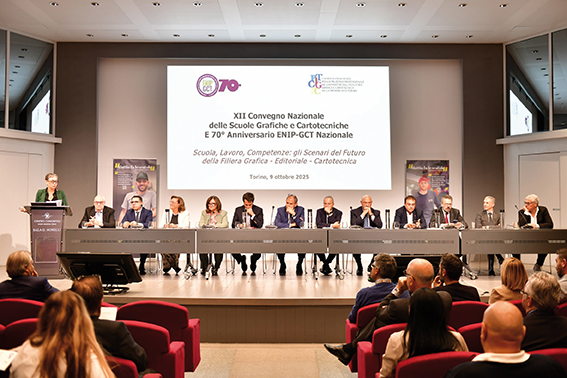
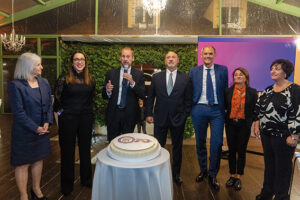
The Conference, organized in collaboration with the ENIP-GCT Provincial Committee of Turin, opened with a symbolic and cultural moment, a guided tour of the Egyptian Museum of Turin, followed by the Gala Dinner at Vigna Chinet, an occasion that officially celebrated the role of ENIP-GCT in connecting generations of students, teachers, trainers, companies and trade associations.
The core sessions of the Conference took place in a prestigious venue, the Agnelli Hall of the Conference Center of Turin Industrial Union, and began with the official presentation and screening of the orientation docufilm “Mattia makes boxes – Stories of young people in the factory”, already previewed during the last Print4all in Milan. A project by ENIP-GCT in
collaboration with Assografici, Assocarta, ARGI and ACIMGA, and with the patronage of the Italian Paper and Graphics Federation, the film directly, accessibly and engagingly showcases the professional opportunities available today in printing and packaging, conveying the voices, language and perspectives of young people.
The day’s program then offered a space for discussion on topics central to the future of the sector: the evolution of training models and youth career guidance; the impact of Artificial Intelligence on educational and production processes; the role of safety and technical culture as competitive assets; dialogue among schools, companies, associations and local communities.
In the afternoon, the focus shifted to design and the value of graphic design in packaging, with a dedicated talk on fonts, visual perception and the language of forms, further proof of how technique and creativity continue to intertwine in defining a product’s identity and recognizability.
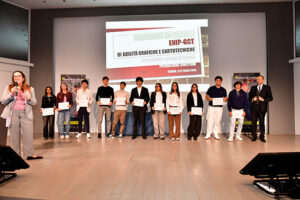
The Conference concluded with the awards celebrating the 70th anniversary of ENIP-GCT and with the ENIP-GCT Schools Contest of Turin, emphasizing the importance of recognizing and promoting emerging talent and training institutions that view innovation as a driver of continuity and renewal for the entire sector.

Face to face with Tommaso Savio Martinico, National General Secretary of ENIP-GCT, who moderated and closed the sessions of the XII ENIP-GCT Conference
ENIP-GCT is celebrating 70 years. How has the Organization managed to evolve in step with the technological and production changes of the graphic and paperboard supply chain?
“We like to consider this anniversary not as a number, but as a journey filled with history, innovation, services and passion for graphics and paperboard manufacturing. Over the years, our mission has evolved: we have sought, and continue to seek, to adapt to the constant changes that have shaped our sector. We are not alone in this journey; we have always worked supported by the valuable collaboration of our Founding Bodies (Assografici, SLC-CGIL, FISTEL-CISL and UILCOM), of the 35 graphic-paperboard schools currently recognized, our 9 regional branches, and all the trade associations and machinery manufacturers close to us”.
Today more than ever we hear about attracting talent. What levers is ENIP-GCT working on to make the sector more appealing to the new generations?
“In recent months, with the support of Assografici, Assocarta, ARGI, ACIMGA and the Italian Paper and Graphics Federation, we have been working on a project that also originated from a meeting with Minister Valditara, held at the Ministry. The Minister encouraged us to create targeted initiatives to guide young people toward technical and vocational education. Last May at Print4All we presented the teaser of this orientation docufilm titled ‘Mattia makes boxes’, which aims to serve as a tool for attracting lower secondary school students and their families, who are choosing their upper secondary school, towards discovering the professions offered by our graphic and paperboard schools. When analyzing the needs of our sector, the issue that has emerged, and is increasingly evident, is the lack of skills and trained resources to employ in our companies, and the shortage of young people directed toward our segment. To address this, we invested energy and resources in creating a useful, practical product to show how work inside our companies has changed compared to the past. We want to convey the message that the world of machinery is attractive, dynamic, safe, well-paid, creative and full of career opportunities”.
How can collaboration between schools and companies become more structured and continuous, avoiding episodic initiatives?
“School–industry collaboration is a crucial issue for making the connection between training and the world of work truly effective. It often remains episodic (isolated projects, occasional internships, one-off initiatives) because a stable structure for dialogue and co-design is lacking. To make it more continuous and systemic, action is needed on several levels, and this is something we do well, if I may say so. As ENIP-GCT National, we have always participated in working groups with schools, companies, local authorities and trade associations; we are now at the 4th renewal of a three-year Memorandum of Understanding, signed exclusively with the Ministry of Education, titled: ‘Strengthening young people’s skills for their guidance and future employability’, which defines long-term objectives, roles, teacher training and monitoring tools. In collaboration with our member companies, we promote work-based learning experiences and internships to meet the real needs of the production system. For several years now, our website has featured a dedicated section for matching job demand and offer: member companies seeking skills can post job offers for free, and applicants can submit their CVs directly to the company. We have always believed in the importance of developing vertical supply chains, and we are founding members of two important ITS Academies: ITS Angelo Rizzoli in Milan and ITS Maria Gaetana Agnesi in Rome, key institutions in ensuring continuity and concrete job opportunities after training”.
What are the strategic priorities of the Organization for the coming years? Are there any ongoing projects you consider emblematic?
“In 2023 we launched an evolving e-learning platform with the aim of offering graphic and paperboard companies and sector schools a comprehensive environment containing video lessons, educational materials, handouts, technical and cross-disciplinary documents useful for continuous training. We could not ignore the widespread expansion of AI across all fields and sectors, including ours. For this reason, we are working to introduce AI into the platform mentioned above, following the needs and expectations of our association network. In line with this, we are seeking to further strengthen our Organization, aligning it with society developments and providing useful tools for students, companies and trainers. Finally, we strongly believe in our Training Call, a project launched in 2023 and now in its third edition: in 2026 ENIP-GCT National will allocate a budget of €210,000 to its member companies and training institutons to support courses and training activities aimed at upskilling and reskilling workers”.
How do you envision the role of the graphic/paperboard technician of the future, in light of AI, automation and new production flows?
“The widespread introduction of AI and automation will reduce (and is already reducing) repetitive and manual tasks. The technician of the future will therefore need to: design and supervise digital workflows (from prepress to finishing, to logistics); integrate software and machines: understand MIS systems, interfaces with generative AI and with production robots; define automation rules rather than execute individual operations.
In short: fewer ‘hands on the machine’, more ‘mind on the process’, and, as I always say, they will no longer get their hands dirty with ink as in the past. AI will become a true design assistant for generating layouts, colour variants, optimizing materials, reducing waste and assessing project sustainability. There will be increasing convergence between printing, packaging, logistics and sustainability. We’re talking about a very near future, actually the present: the future is now, and we must not be caught unprepared”.