








In Italian box factories, there’s a productivity reserve that’s often underestimated. It’s not always found in a new machine, a plant investment, or an increase in shifts.
These are examples of increased production capacity, not productivity. Companies typically use this approach as a countermeasure to rising orders, but without focusing on process efficiency. This efficiency is most often hidden in a specific point in the production process: the time between the end of one order and the start of the next. It’s the moment when the machine isn’t producing good cardboard, but continues to generate costs. It’s the moment when operators, machine managers, maintenance, programming, and quality intersect around adjustments, format changes, preparations, checks, and operational micro-decisions. If not managed methodically, this time accumulates minutes that over the course of a year become hours, days, and, in many cases, hundreds of thousands of euros of unused capacity.
By Induvation
In cardboard packaging, where the market demands batch reduction, orders are increasing, and the level of service required is ever higher, machine start-up can no longer be considered a simple departmental issue. It is a proactive response strategy to what companies ask for.
How much is a minute of start-up worth?
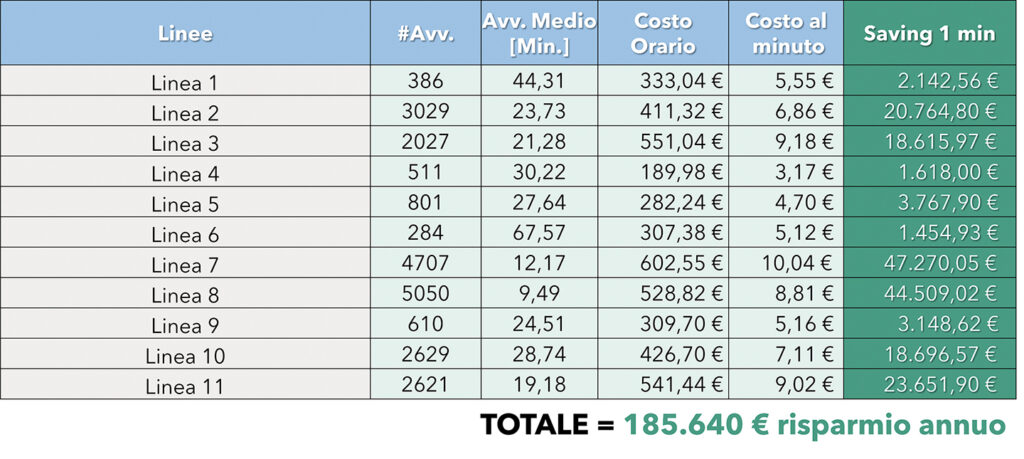
The starting question is simple: how much is a minute of start-up saved on each order in a year worth?
The calculation is straightforward:
Annual value of 1 minute = (machine hourly cost / 60) × (number of start-ups per year)
Applied to die-cutters, folder-gluers, flexo lines, or case makers, this formula transforms an operational issue into an economic indicator that can also be understood at the management level. During our assessments, we found that the annual minute spent on each start-up, including the potential missed sales, can be worth approximately €50,000 per production machine. This figure is significant because it doesn’t involve a revolution in the process, but rather a small improvement repeated over a large number of start-ups.
In the box factory, a minute should never be read in isolation. It should be multiplied by the number of changeovers, the lines involved, the shifts, the frequency with which the process is repeated, and of course by the potential reduction of a start-up, which, in our experience, can be halved in many cases.
Start-up must be planned, not just sped up.
In many companies, start-up is still managed as a sequence of activities entrusted to the experience of operators. Experience remains essential, but when the process depends too much on individual people, variability, downtime, and the difficulty of replicating the best performance increase. The same format changeover can take very different times depending on the shift, the sequence of orders, the availability of dies, plates, inks, pallets, equipment, technical information, approved samples, and the quality of the line load. In some cases, the problem isn’t the machine: it’s what happens around the machine before and during start-up. For this reason, a change of perspective is needed: start-up shouldn’t simply be “speeded up”, it must be designed.
A good plan doesn’t ask operators to rush. On the contrary, it eliminates the conditions that force them to waste time: searching for materials, waiting for instructions, repeating adjustments, solving predictable problems, or compensating with experience for what should be standardized.
The start-up pit stop model
An effective image is the pit stop: in Formula 1, downtime isn’t reduced by asking mechanics to improvise more quickly. It’s reduced by defining roles, sequences, equipment, positioning, and standards. The same principle can be applied to the box factory.
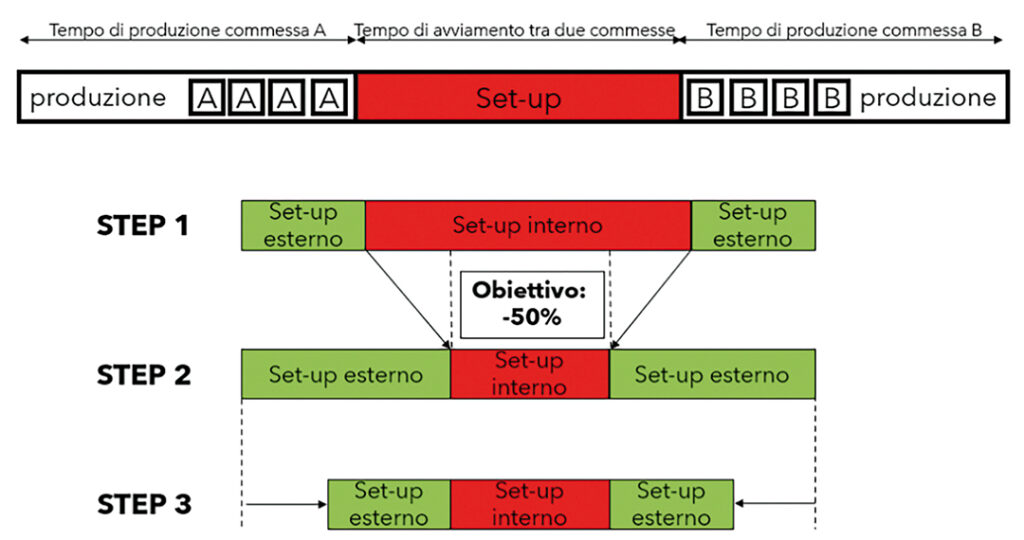
The start-up pit stop is a structured process that analyzes the job changeover considering its real elements, distinguishes what must be done while the machine is idle from what can be prepared in advance, eliminates unnecessary activities, and builds a replicable operating standard.

Towards the operational reduction of setup time
The process is developed in five operational phases.
The first is to analyze the most common start-ups, selecting the most recurring and relevant cases for the box factory. The goal is to start with the order changes that truly impact daily productivity, not exceptional situations.
The second phase consists of mapping the activities performed during the As-Is start-up. A real changeover is observed, filmed, timed, and broken down into micro-activities. Typically, ad hoc software is used to objectively analyze the setup in all its components. It’s not about evaluating people, but rather making the process visible: waiting times, unnecessary movements, late checks, unready materials, repeated adjustments.
The third phase is defining the To-Be start-up process together with the operators. Each activity is analyzed to determine whether it can be eliminated, simplified, brought forward, or moved outside of the machine downtime. Very concrete solutions emerge here: start-up kits prepared in advance, preventive testing of dies and plates, inks available at the required viscosity, equipped trolleys, tools on board the machine correctly arranged according to the 5S of Lean Production, job checklists, and clearer rules for information transfer. Furthermore, scheduling must be coordinated with operators, respecting the machine’s optimization priorities.
The fourth phase involves implementing and evaluating the identified improvements. Ideas are transformed into operational actions, assigned to managers, and integrated into daily work: organizational improvements are implemented directly, while those requiring investment are evaluated through ROI, starting from the economic value of one minute saved. If the investment pays for itself within a reasonable time, it is implemented.
The fifth phase is monitoring performance over time. Improvement must become a measured and shared standard, capable of maintaining results and generating new optimization opportunities. This phase includes the SMED audit, which must be performed regularly by the shift manager.
Prepare early to stop less
One of the most effective principles involves distinguishing between activities that must be performed while the machine is idle and activities that can be brought forward. In a box factory, many operations considered “normal” during downtime can actually be prepared in advance: die-cut checks, plate checks, ink availability, pallet setup, tool retrieval, technical specification confirmation, quality assurance, and production sequence control.
The guiding question is always the same: does this activity really need to be performed while the machine is down? Every time the answer is no, an opportunity for improvement arises. Job changeovers don’t begin when the last box of the previous job leaves the line, but earlier, while the machine is still producing.
Job sequence also matters
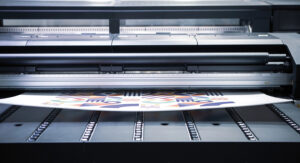
Makeready time doesn’t depend solely on the production department. Scheduling also has a significant impact. The sequence in which jobs are sent to the machine can simplify or complicate the work: color changes, knife settings, die cuts, solids, formats, and print configurations can generate very different makeready times. Grouping technically compatible jobs can significantly reduce downtime. In this sense, the CDS (code scheduling) workshop can be useful to ensure that programming and production speak the same language.
A concrete case: from 24 to 13 minutes
The numbers help understand the scope of the issue
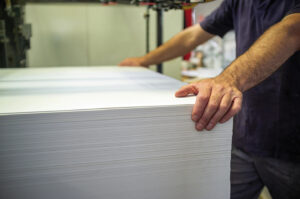
On a line that we analyzed, the average makeready time was approximately 24 minutes. Through structured process analysis, identification of activities to be brought forward, and definition of organizational, technical, and service interventions for the line, the target time was reduced to 13 minutes, a 45% reduction.
The improvement was therefore approximately 11 minutes per start-up. Considering 3,029 start-ups per year and an hourly machine cost of €400, the potential benefit on a single line was approximately €222,000 per year.
It’s not just the euros that count: the time saved can translate into additional production shifts available throughout the year. A shorter start-up also changes the calculation of the economic batch size, making smaller batches more cost-effective and allowing the company to respond more quickly and flexibly to market demands.
Every minute saved goes back into production.
Reducing start-up times doesn’t mean requiring production to work under greater pressure, but the opposite. It means eliminating waste, clarifying processes, anticipating what can be prepared earlier, and enabling workers to work better and with less stress.
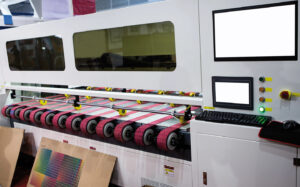
In box factories, potential isn’t always visible in end-of-month reports. It’s often hidden in the transitions between orders, in what are considered normal waits, in non-standardized activities, in information arriving late, in repeated adjustments, and in the minutes lost many times a day.
When these minutes are measured, analyzed, and transformed into a more stable process, they become production capacity, margin, and customer service. Every minute recovered in start-up is a minute returned to production. And in a box factory, multiplied by hundreds or thousands of orders a year, that minute can be worth much more than you might imagine.