




With a solid background in production printing, which reached 20 years in 2026, Konica Minolta officially launched its label printing division in 2016. In this decade, the company transitioned from being an outsider to a recognized leader in the digital label printing industry. Today, there are over 1,700 installations worldwide, 90 in Italy.
After ten years in production printing and a long-standing tradition in photography and image management, with expertise also developed in the medical field and colorimetry, Konica Minolta decided to enter the label market. The company realized that the most significant evolution, in terms of volume, revenue, and development, would be concentrated in the packaging and label sector. This led to their decision to invest in digital printing for this segment, a decision that proved to be farsighted, anticipating the market’s increasing demand for flexibility, speed, and customization.
The debut of bizhub PRESS C71cf
Konica Minolta’s first entry into the label sector was marked by the launch of bizhub PRESS C71cf, an entry-level machine for the industrial label market, presented at Labelexpo. The solution was based on a toner printing engine from production printing, to which the Japanese company added an unwinder and rewinder supplied by Miyakoshi. The result was a simple and robust machine, whose suffix, bizhub, still identifies the brand’s office solutions.
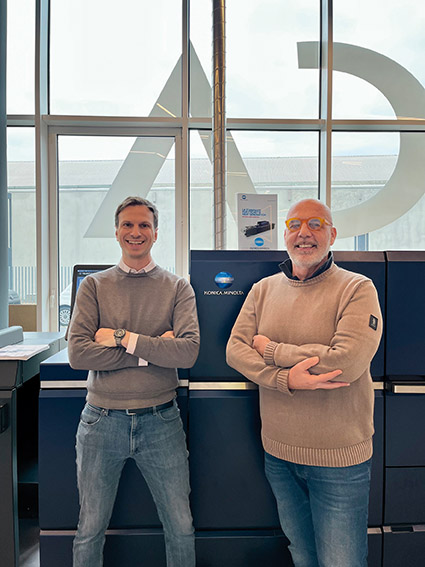
“Although the competition was primarily composed of long-established players in analog printing and digital inkjet, the bizhub C71cf immediately sparked great curiosity. Visitors at Labelexpo were surprised to see a player with no history in industrial printing, but the interest generated was very strong from the outset, both in Italy and across Europe. The machine’s sturdiness and ease of maintenance made it especially appreciated, to the point that many of the first installations are still operational. The simplicity of toner technology is one of its strengths: it makes the machine extremely durable over time. This is why toner machines can be considered little tanks”, explains Alessandro Viganò, Product Manager of Industrial Printing at Konica Minolta Italia.
The evolution: AccurioLabel 190, 230, and 400
In 2017, Konica Minolta took another step forward with the launch of Accurio Label 190, developed with support from Grafisk Maskinfabrik (GM), a specialist in finishing systems, a partnership that is still active today. In this case, the engine was derived from production printing, but with an increased speed of up to 19 meters per minute.
Two years later, the AccurioLabel 230 was introduced, which increased the speed to 23 meters per minute, further strengthening the company’s presence in the label market.
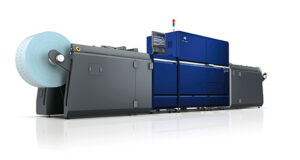
The growth continued in 2023 with the introduction of AccurioLabel 400, a new machine equipped with IQ as standard and a fifth color channel dedicated to white, capable of reaching 40 m/min with a resolution of 1,200 x 2,400 dpi.
“This solution represented a real leap forward for Konica Minolta, firmly establishing the company as one of the major suppliers of digital printing systems. When the company first ventured into the label world, it was, in some way, taking a bold leap. But today, the numbers speak for themselves: over 90 machines in Italy, with similar results in Europe and worldwide, totaling more than 1,700 installations”, highlights Alessandro.

Success in Italy and market response
Italy is one of the countries where Konica Minolta has achieved the most significant results. The company was among the first to target a market segment that was previously under-served: digital label printing for short runs. Analog machines could not efficiently meet the needs of limited production runs, up to 1,600 meters, which were economically unfeasible with traditional systems. At the same time, the inkjet solutions available at the time had limitations in printing on uncoated substrates and had lower production speeds.
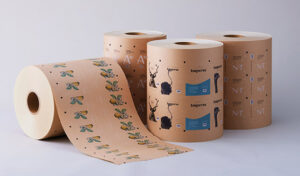
“Konica Minolta, on the other hand, was able to ensure not only good production speeds but also high application flexibility, allowing printing on a wide range of materials, including natural papers and uncoated substrates, which are particularly requested in sectors such as the wine industry”, highlights Alessandro.
AccurioLabel series has therefore established itself as a strategic choice both for commercial printers looking to diversify their offerings and for label manufacturers seeking sustainable investments and quick economic returns.
The solutions are particularly well-suited for small and medium-sized enterprises thanks to their ease of use, both from a software and operational perspective, as well as support for streamlined and optimized workflows. They are also ideal for high-quality just-in-time production, leveraging the advantages of toner technology, which is safe and environmentally conscious: Konica Minolta toners are certified for food contact, free from mineral oils, and ensure complete de-inking, thus supporting recycling processes and reducing environmental impact.
Software and printing ecosystem
On the software side, Konica Minolta offers advanced yet intuitive solutions such as AccurioPro Label Impose and AccurioPro Flux. The 10.2 version of AccurioPro Flux for professional printing allows for efficient job preparation, workflow automation, improved operator collaboration, and effective management of the finished product. The software plays a central role in enhancing the machine’s performance, enabling each system to fully express its potential.
“A fast, digital machine that’s easy to use, without software to enhance its functions, is not enough. This is where Konica Minolta has made the difference, offering an integrated ecosystem that goes beyond the printing machine. It’s not enough to print well: managing the entire production flow effectively is crucial”, concludes Alessandro.
Not by chance, the company’s professional printing platforms are identified by the prefix “Accurio,” synonymous with care, quality, and precision. In the field of digital label finishing, Konica Minolta also collaborates with MGI, in which it holds a majority stake.
The latest product of this collaboration is the JETvarnish 3D Web 400, a pioneering digital roll finishing system for labels. After previews in previous years, it was officially presented at Labelexpo Barcelona. JV3D Web 400 is the roll-to-roll digital solution that revolutionizes label and flexible packaging finishing: spot UV varnish and hot foil in a single pass, with variable data management and thicknesses up to 112 microns. It guarantees productivity, flexibility, and premium quality, reducing setup times and waste thanks to the AIS SmartScanner. A modular and scalable system that meets the needs for flexibility, customization, and time-to-market.
A look to the future
 At Labelexpo 2025, Konica Minolta raised the bar further with the presentation of the new prototype AccurioLabel 231, a system designed to push automation and productivity beyond the limits known so far in digital label printing. Based on the proven success of the AccurioLabel 230, the prototype integrates an optional Intelligent Quality Optimiser (IQ) that simplifies workflows, enables extended runs of up to 1,600 linear meters, and maintains color register accuracy even at maximum operating speeds.
The print resolution, boosted to 1,200 × 2,400 dpi, promises even sharper and more vivid results, setting a new quality standard for mid-range digital production.
The debut of this prototype is not only a technological preview: it’s a clear sign of how Konica Minolta is interpreting the emerging needs of a rapidly transforming market, addressing challenges such as the rise of on-demand runs, process automation, the shortage of qualified operators, and the increasing demands for environmental sustainability.
In a decade, Konica Minolta has therefore pushed the limits of digital printing, transforming an innovative vision into a concrete and widely appreciated reality.
With over 1,700 installations that attest the reliability and effectiveness of its solutions, the company is not merely looking to the future: it’s already building it. Today, embracing tomorrow means thinking beyond printing: it means shaping an industry that, thanks to technology, automation, and creativity, can dynamically meet the needs of brands, printers, and consumers.