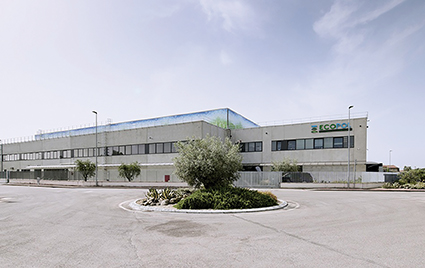







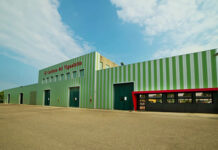

Founded in 2009 in Lucca with 10 collaborators, Ecopol is now a well-established company with two locations in Italy and one in the United States, employing around 250 people. It is the leading European producer and the second-largest in the world for the production of water-soluble PVOH films. Together with Henkel and Nordmeccanica, it sponsored the recent Giflex conference in Rome, where it presented itself through the words of its vice president of sales and marketing to an audience of printers and converters, with a speech focused on technical and innovative aspects
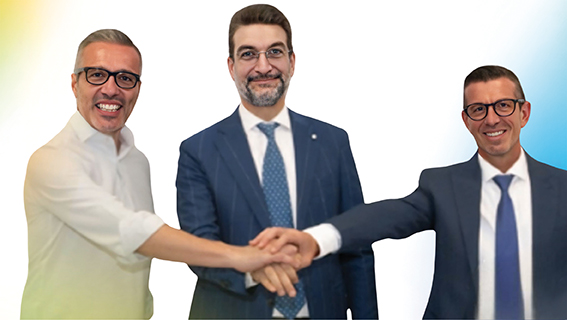
After a long career at Henkel, Mauro Bonfiglio has been Ecopol’s vice president of sales and marketing for just over a year. Ecopol is a relatively young Italian company, but with a leadership role in Europe in the field of water-soluble polymer production, and is the second-largest player globally. We’ve all, at least once, started the dishwasher or washing machine with one of those detergent capsules wrapped in a biodegradable film that dissolves during the wash. These products are developed and manufactured in Italy by Ecopol, which has two production sites in the country and, since 2023, also in the United States. The applications for these products are wide-ranging, spanning the cleaning and detergent sectors, barrier films for packaging, and even special applications in building sector.
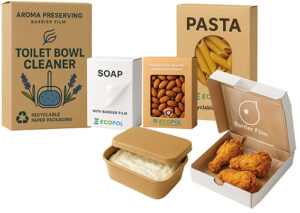
The new face of sustainable packaging: paper and PVOH together for fully recyclable solutions through collaboration with leading companies
Innovation today cannot be pursued alone; it’s a journey that must be built together with key stakeholders in the supply chain, because true innovations arise when different companies decide to work together, sharing expertise, laboratories, tests, and a common vision.
“PPWR is an accelerator because it forces the entire supply chain to truly question materials, recyclability, and circular design. The 2026 deadline, when the regulations will become binding, is a turning point: those who don’t move today risk being left out of the market tomorrow”, says Mauro Bonfiglio.
The core of the project presented by Ecopol is a paper/PVOH laminate, fully recyclable in the paper recycling stream, developed with two partners, leaders in their respective fields, representing key pillars in the industry. We’re talking about Henkel for high-performance waterborne coatings and adhesives and Nordmeccanica, which has deployed cutting-edge lamination technologies capable of managing lamination of ultra-thin films, ensuring precision, quality, and reliability in the production process.
The packaging is based on lamination of water-soluble PVOH film with paper as structural support. Paper provides rigidity and printability, while PVOH ensures barrier functionality and heat-sealability. High-performance coatings and adhesives developed by Henkel offer effective barriers against water vapor. In combination with waterborne adhesives, they ensure optimal product protection, offering a sustainable and balanced solution in terms of cost and performance.
The lamination process was then tested by Nordmeccanica at Ecopol’s R&D center, identifying the optimal solution for coating and laminating, in order to design machines that meet the demands of new materials and coatings intended for sustainable packaging.
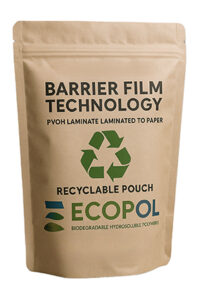
Next-generation PVOH: maximum performance and certified recyclability
The water-soluble film developed by Ecopol, also available in a BIO-based version, is the core of the project. This material not only guarantees barriers against oxygen, humidity, fats, mineral oils, and MOSH/MOAH, but it also has a decisive feature: it does not produce microplastics and achieves the highest rating for paper recyclability. Many sustainable materials work well in theory, but not so well when they actually go into production. However, the paper/PVOH laminate has been designed to run on standard lines without modifications to the equipment. Welding tests showed a typical behavior of robust materials: under tensile testing, the paper tears, leaving fibers on the PVOH, which indicates an effective and consistent bond.
Recyclability confirmed by CEPI 4evergreen
The material passed all the stages outlined by the CEPI 4evergreen protocol, earning the status of “recyclable” according to European standards. This certification makes it fully aligned with the PPWR and very appealing to brand owners and retailers.
“Through this project, we’ve managed to demonstrate to the market the validity of this solution, which is based on four key pillars: functionality, sustainability, the use of materials from renewable sources, and machinability. Ecopol is already working on new papers, advanced coatings, and even higher-performing PVOH formulations. Our work doesn’t end here, because sustainability is not a goal: it’s a continuous process”, concludes Mauro Bonfiglio.
Face to face with Mauro Bonfiglio, vice president of sales and marketing at Ecopol, and Tazio Zerbini, VP of R&D at Ecopol
How complex was it to integrate different worlds such as paper, chemistry, and lamination technology, and what lessons have you taken away from this co-innovation project?
“The real challenge wasn’t technological, but cultural: overcoming different logics and languages to think about the packaging system as a whole. The key was working as a unique supply chain team, sharing data, tests, and objectives, and incorporating industrialization into the development process from the earliest stages. This approach allowed us to turn innovation into a concrete, scalable, and credible solution for the market”.
From the perspective of brand owners, which levers do you think will be decisive in accelerating the adoption of paper/PVOH solutions compared to other approaches currently on the table?
“For brand owners, the adoption of paper/PVOH solutions will be driven by three main levers. The first is regulatory: PPWR pushes towards materials that are truly recyclable and compatible with existing supply chains. The second is communication: packaging primarily made of paper and recyclable in paper collection is easy to explain and credible to consumers. The third regards performance: the high barrier performance achieved eliminates the fear of sacrificing safety and shelf life when choosing more sustainable solutions”.
Looking at the coming years, which applications do you see as the most promising for water-soluble polymers, and what technological developments will be key in further expanding their adoption in packaging?
“The most promising applications for water-soluble polymers will be those where safety, functionality, and sustainability can coexist without compromise. I see strong potential in paper-based packaging with functional barriers, particularly for dry food, pet food, fatty products, and those sensitive to oxygen, where PVOH can provide high barrier performance while remaining compatible with paper recycling.
Another key area is single-dose and unit-dose systems, for both food and non-food. Here, the value of PVOH is already recognized, but in the coming years, it can expand further thanks to more robust, bio-based formulations that are adaptable to different industrial processes.
From a technological development perspective, I believe that a holistic approach to packaging will be crucial. We will need to integrate different technologies and materials to achieve the desired results. Specifically, I see three key areas that will be crucial for accelerating adoption: improving performance under critical conditions, particularly moisture resistance, to expand the range of possible applications; increasingly efficient integration with coatings, adhesives, and lamination processes, as demonstrated in the supply chain project with Henkel and Nordmeccanica; and, finally, industrial scalability and processability, that is materials designed from the start to work on existing lines, reducing entry barriers for converters and brand owners”.