





From planning to operational excellence in box factories and cardboard converters
In the cardboard industry, competitiveness is no longer based on price alone. It now depends on the ability to keep the promises made to customers, meeting deadlines, quality standards, and flexibility requirements without compromising profitability.
In the previous article, we addressed the topic of planning and order management, namely the stage in which the company makes crucial decisions about what to produce, when to produce it, and with which resources.
With this contribution, we move into the next phase: Execution & Fulfillment, the moment when those decisions must be translated into real output. It is precisely here that a fundamental distinction emerges: on one side, companies that constantly chase daily problems; on the other, those that truly govern their operations and production processes.
This will be the last general article in this series. From now on, we will dive into details, sharing and exploring our direct experience as organizational consultants in the cardboard industry.
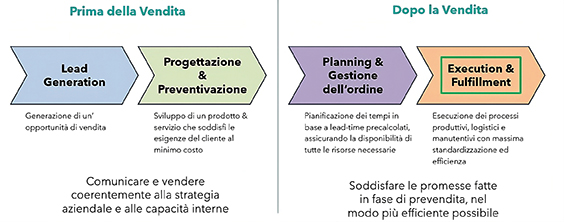
Execution and fulfillment in a box factory and in a cardboard converter
In a box factory and in a cardboard converter, execution and fulfillment represents the set of processes that enable a plan to be transformed into a concrete result (a finished and delivered order of cardboard packaging).
We’re talking about:
- production processes
- internal and production logistics (die-cutting, printing plates, colors, etc.)
- machine and maintenance management
- operational coordination of personnel
The goal is clear: to fulfill the promises made during the pre-sales phase as efficiently as possible, ensuring stability, quality, and compliance with lead times. There’s a detail that’s often overlooked: execution isn’t the moment in which you decide what to do and how, but rather the moment in which you execute decisions already made within the company’s macro-processes. If the previous phases, i.e. design, budgeting and planning, have been carried out consistently and effectively, execution will be a controlled process, where the focus can be placed on improving operational performance rather than on daily emergencies.
The continuous improvement of operations in cardboard sector
When we talk about continuous improvement in the cardboard industry, we’re not talking about theory, but about real, measurable efficiency, implemented on a daily basis.
Continuous improvement in operations means:
- reducing hidden waste
- increasing machine availability
- stabilizing processes
- improving customer service
The Lean philosophy, born from Japanese culture, teaches that every process can be improved. Not through complete revolutions, but through small, constant steps, the so-called Kaizen: a continuous change. The real leap in quality occurs when continuous improvement isn’t simply left to the goodwill of individuals, but becomes a structured and integrated operations management system.
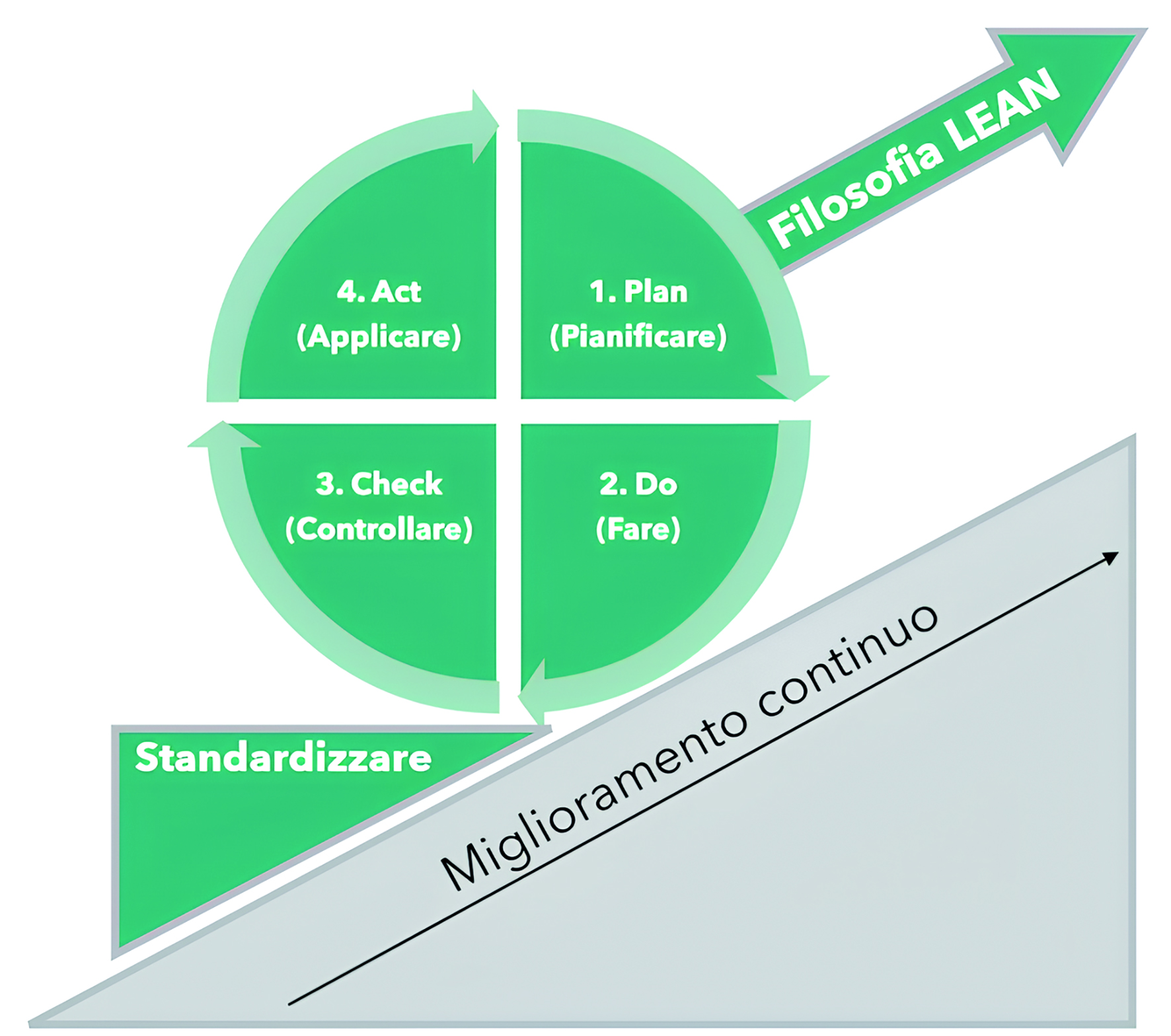
The PDCA cycle begins with the Plan phase, in which processes are analyzed, clear objectives are defined, and consistent working methods are established. With the Do phase, solutions are implemented in the field, while the Check phase allows results to be measured and their effectiveness evaluated. It is in the Act phase that a key step emerges: standardizing what works, transforming best practices into shared and repeatable rules.
Standardization creates a solid and stable foundation, essential for avoiding regressions and waste. On this foundation, the PDCA wheel can continue to turn, fueling structured and sustainable continuous improvement, fully consistent with the Lean philosophy applied to the cardboard industry.
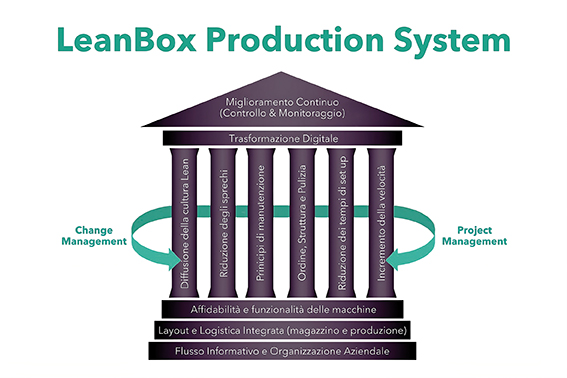
LeanBox production system by Induvation: the compass for operational excellence
To make continuous improvement concrete and manageable, a clear system is needed. In this sector, this role is fulfilled by Induvation’s LeanBox Production System: a continuous improvement management model developed for paper and cardboard packaging industry.
This model is based on a simple yet powerful foundation, clarifying a concept that is often unclear to cardboard companies: efficiency cannot be built without first building stability (process standardization).
In Induvation’s Lean Box Production System, the foundations represent the stability of the production system: reliable machines, clear logistics flows, and defined organizational processes, without which any improvement is destined to fail. On this foundation, the pillars are built, i.e., the operational levers that increase daily efficiency: waste elimination, work standards, reduced start-up times, and the spread of a culture of change. The ceiling is the final objective: standardization, performance measurement, digitalization, and the company’s ability to independently manage continuous improvement.
Connecting and making the entire system effective is Change & Project Management, a fundamental skill for guiding change, aligning people, and transforming the method into concrete and sustainable results over time.
The foundations of the LeanBox Production System
To achieve a truly high-performance production line, it’s not enough to intervene on a single machine: it’s necessary to improve the entire production system. The foundations of the LeanBox Production System have precisely this objective and focus on operational stability, a prerequisite for any lasting improvement. Specifically, it addresses three key areas:
- Machine reliability and functionality, aimed at reducing downtime and system anomalies, involving both maintenance personnel and line operators to ensure production continuity and consistent quality.
- Integrated layout and logistics, based on the “Just in Time” concept, to ensure the availability of dies, colors, systems, samples, and cardboard according to the 6 Gs of logistics: right goods, at the right time, in the right place, in the right quantity, with the right quality, and in the right way.
- Information flow and company organization, from the quotation stage to shipping, to interconnect office activities and ensure consistency between planning and production.
Without a solid foundation, any efficiency improvement initiative risks generating instability rather than results.
The pillars: operational discipline and focus on critical factors
The pillars of the LeanBox Production System represent the concrete and standardized approach with which the company governs and improves its production lines. As already stated, increased productivity does not arise from isolated actions, but from rigorous and continuous management of several key factors, including:
- systematic reduction of set-up times;
- continuous optimization of jobs ordering;
- increased production speed under stable conditions;
- reduction of machine downtime, both organizational and technical;
- creation and maintenance of order, structure, and cleanliness along the line;
- involvement and ongoing training of operational staff.
It is the daily attention to these elements, often considered “details,” that generates concrete and sustainable results. Productivity increases when operational discipline becomes an integral part of the corporate culture. This is a K.O. criterion for the diffusion of continuous improvement within a company: change starts with people, who must believe in this philosophy and cultivate it every day.
The ceiling: measurement, standards, and continuous improvement
The ceiling of the LeanBox Production System represents the company’s ability to improve over time in a structured and conscious manner. The underlying principle is simple: you can’t improve what you don’t measure.
Continuous improvement is based on three essential elements:
- Controlling (clear and shared performance indicators), which transforms objectives into numbers and allows for objective monitoring of results;
- Monitoring (continuous improvement cycles), based on planning, action, verification of results, and standardization, to avoid losing the results achieved and continually test new solutions (based on the PDCA cycle described above).
- Digital Transformation, which plays an enabling role: it doesn’t replace the method, but strengthens it, making data and information accessible, reliable, and useful for operational decisions.
Change & Project Management: the belt that enables change
Foundations, pillars, and ceiling do not produce lasting value without conscious change management. There is a fundamental ingredient, without which Lean projects in manufacturing could lose their potential and effectiveness.
Change & Project Management is the true heart of the LeanBox Production System: the element that holds together method, people, and results, ensuring that all the work done is not lost and creates efficiency over time.
Managing change means accompanying the organization in the evolution of its operational mindset, working on:
- alignment of function managers, from logistics to production to sales;
- active involvement of people in improvement projects, the true driving force without which change cannot occur;
- growth and motivation of key personnel to create and spread the culture of change every day within the company;
- clear communication of objectives, priorities, and expected benefits;
- respecting the timeframes necessary for new working methods to become habit.
Project Management, furthermore, provides the common thread that connects initiatives, manages complexity, and ensures consistency between the various improvement activities. This is precisely where the difference lies between projects that are implemented over time, bringing value to the company, and projects that begin but then quickly fall back into the classic “we’ve always done it this way”: project management is the true secret of long-term success of continuous improvement.
Without it, operational project activities begin, but the wheel of change fails to truly kick-start, resulting in a relapse into old habits and even generating discontent within the project team.
Digitalization and shopfloor management: making execution visible
Continuous improvement, as previously mentioned, only exists if it is measured. Dashboards, KPIs, MES systems, and Shopfloor Management Systems allow you to visualize performance, monitor progress in a structured and visible way across the entire department, and govern improvement projects.
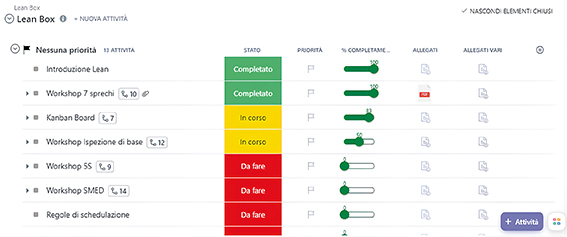
It must be clear, however, that digitalization is not a starting point, but rather an accelerator, which only works if processes are already clear and standardized from the outset. To better manage the progress of improvement projects and effectively monitor activities, the use of a Project Management Tool is also recommended.
It’s often thought that Lean projects are characterized by post-it notes or paper notes placed throughout the factory. This approach has evolved over the years: it’s now possible to manage Lean Continuous Improvement projects digitally. Similar tools allow the project team to know the most up-to-date status of projects, assign operational tasks, identify critical issues, and have both a general and detailed overview of ongoing activities.
Execution as a strategic lever
Execution and fulfillment, therefore, is not a secondary operational phase, but rather the moment in which we verify whether business processes have been correctly defined and implemented.
When upstream processes are robust, execution becomes an opportunity to:
- improve efficiency
- increase margins
- build customer reliability
In the most advanced box factories and cardboard converting plants, execution is not just execution, but daily operational excellence with a view to continuous improvement.