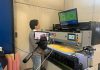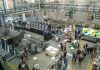



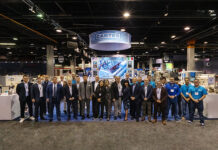
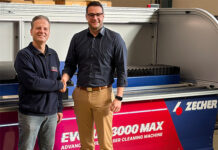
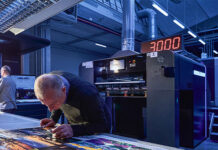

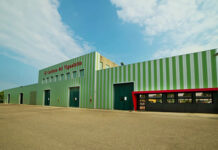
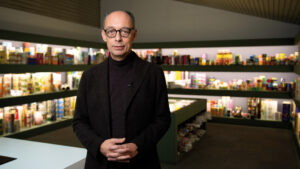
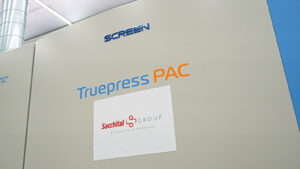
The journey that led Sacchital to become the first company in the world to install the SCREEN Truepress PAC 520P digital printing technology is rooted in a history running through more than eighty years of industrial evolution, encompassing every printing technology. We visited the company at its headquarters in Pregnana Milanese (Milan) to see the machine in action and conduct a video interview with Alberto Palaveri, Executive Member of the Board, and with contributions from Juan Cano of SCREEN and Ettore Maretti of REM
The first SCREEN PAC 520P digital printing press for flexible paper packaging was a natural fit for Sacchital, a specialist in paper bags and packaging, primarily for the food industry, since 1945. This first installation not only represents a technological primacy, but also marks a paradigm shift in the way Sacchital engages with brands: no longer just production capacity, but also agility, rapid response, and the ability to test the market with ready-to-deliver digitally printed paper solutions.
“The paper packaging market is also ready for high-productivity digital technologies. We knew the first installation would be in Europe, and we had a very clear feeling that Sacchital was the right partner to pioneer this path”, confirms Juan Cano, Business Development Director at SCREEN, who has in-depth knowledge of our market, having previously worked for leading companies in the sector in our region.
Why digital? An industrial choice rather than a technological one
With constant growth, Sacchital has expanded its portfolio over the years to become a European leader in high-barrier solutions, paper-based laminates, and low-environmental-impact laminates. The Group, which today also includes
Åkerlund & Rausing, a historic Swedish brand founded in 1929, has built its identity around three pillars: materials research, process quality, and measurable sustainability. This philosophy is perfectly summarized by Alberto Palaveri, Executive Member of the Board of Sacchital and CEO of
Åkerlund & Rausing: “we are convinced that sustainability and performance must coexist without compromise. Innovation, for us, is not an accessory but part of our DNA”.
With a portfolio spanning food, cosmetics, pharmaceuticals, pet food, and technical applications, Sacchital has distinguished itself over the years for its customized packaging solutions, often developed in co-design with brands. Shorter print runs, the fragmentation of SKUs, compressed time-to-market, and the arrival of the European PPWR regulation have highlighted the need for a third option alongside flexo and gravure lines. And this is precisely the aspect that deserves further exploration, because the company began as a gravure printer, then expanded to flexo printing and now also to digital: all this without hesitation but with the confidence to seize every growth opportunity, pursuing the path of innovation and, above all, listening to the market’s needs and investing in the right directions accordingly. As Palaveri also emphasized during the video interview, Sacchital had been looking at digital for some time, but lacked a solution that combined true industrial productivity, water-based inks consistent with sustainability objectives, and print quality in line the expectations of major brands. It is precisely this technological convergence that, until now, had never been presented in a single platform.
For Sacchital, investing in digital was not a fad, but rather a natural extension of its strategy of producing what’s needed, when it’s needed, reducing waste with a view to true circularity. This strategy relies on technology that offers brands greater versatility and agility in managing personalization and variable data, enhancing paper-based applications.
The Truepress PAC 520P now allows Sacchital to operate according to a print-on-demand model, drastically reducing waste and packaging obsolescence.
In some cases, delivery times are shortened by up to 48 hours, compared to the weeks required by traditional processes, paving the way for pilot launches, limited editions, market tests, and seasonal campaigns that were previously difficult to carry on. So the company entered into the SCREEN world with a machine that, right from the initial tests, proved to meet the company management’s expectations.
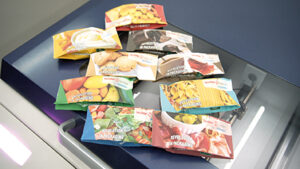
Truepress PAC 520P: digital printing that enables new paper applications
The new machine installed at Milan site uses water-based inks compliant with the strictest European standards and is designed to print on next-generation heat-sealable and recyclable papers.
Sacchital’s Truepress PAC 520P is a compact platform that can be integrated into existing workflows. Thanks to the continued reduction in print runs and the increase in SKUs, this digital printing solution now gives Sacchital an additional tool in its quiver for on-demand printing based on actual needs, minimizing waste. In the paper packaging segment, where quality, sustainability, and flexibility must coexist, PAC 520P represents a tool that enables new business models and supports the transition promoted by PPWR.
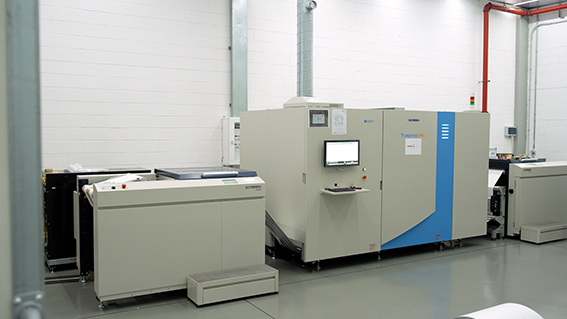
An attractive technology for new generations
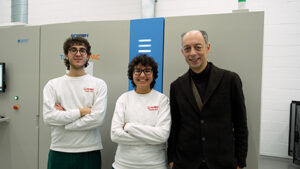
The digital, intuitive, and clean nature of the inkjet process makes PAC 520P particularly suitable for young, digitally-native teams. This helps make the packaging sector more attractive to new generations of graphic designers and technicians, just as Sacchital has done. The company has hired young graduates directly from graphic design schools, forming a team that includes young female operators, under the watchful eye of Felice Ursino, Innovation & QA Director at Sacchital Group.
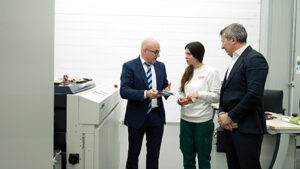
During our visit to Sacchital, the press was working on a major order for the launch of a new product, with the brand owner specifically requesting digital printing for immediate time to market. “Seeing the machine in full production for a major brand owner, with consistent quality from the first to the last meter and at maximum speed is enormously satisfying, because talking about it is one thing, but seeing it firsthand is another. Furthermore, here at Sacchital they’ve hit the nail on the head, creating a team around this new technology made up of young men and women who immediately got into the digital production process”, comments a satisfied Juan Cano as Truepress PAC520P spins non-stop under our eyes at a speed of 80 meters per minute.
A path that looks to the future
 The next step in this new collaboration between Sacchital, SCREEN, and REM DIGITAL involves collaborating on the development of new applications, materials, and integrated solutions. The goal is to position digital printing not only as an alternative to flexo and gravure technologies, but also as a complementary and strategic element for increasingly circular packaging.
“With this project, we haven’t simply installed a machine; we are embarking on a new phase in our industrial journey, working with partners who share our values and vision”, concludes Palaveri. As Palaveri emphasizes, sustainability is only effective if it can be industrialized, measured, and market-compatible.
In this sense, digital inkjet printing on paper is not seen as an alternative to traditional technologies, but as a complementary and strategic element, capable of making sustainability a real competitive factor.
“Sacchital is exactly the type of partner we were looking for to demonstrate to the market the reliability and maturity of our water-based inkjet technology”, concludes Cano. “An industrially solid, visionary, and credible company on the topic of sustainability”.

REM’s support, representing Screen for the Italian market
In the process that led the two companies to choose each other, REM Srl, the Italian distributor of SCREEN technology for labels and packaging, also played a key role. REM completed an evaluation process based on testing, sampling, and simulations of real-world flows. Thanks also to REM’s technical and design support, represented by Ettore Maretti, the relationship, which began on a technical basis, quickly consolidated on a strategic basis: the shared belief that paper will be one of the key materials for sustainable packaging in the coming years.